
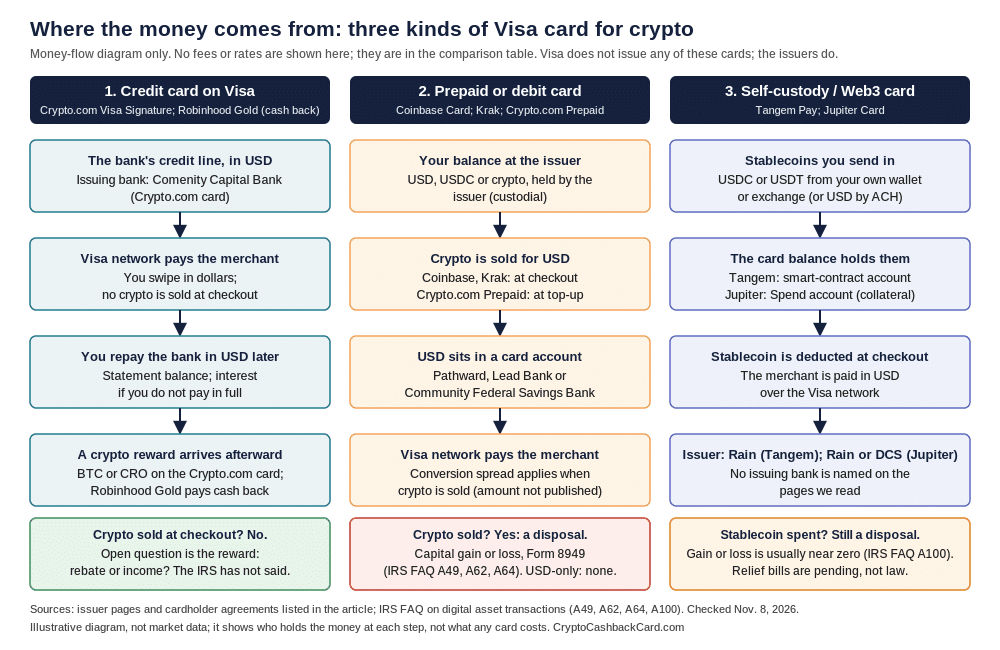
A visa card for cryptocurrency is not one product. Visa does not issue cards; banks do, and the same Visa logo sits on three different machines: a credit card that pays you crypto on dollars you spend, a prepaid or debit card that sells your crypto to pay, and a self-custody card you fund with stablecoins from your own wallet. This guide sorts the US options by that split. It gives a dated table of issuing bank, fees, rewards, excluded states and credit check, and then the tax line that follows from the split. Everything below was checked on issuer pages and cardholder agreements on Nov. 7, 2026 and re-checked Nov. 8, 2026, unless a line says otherwise. Crypto.com Level Up prices, Robinhood foreign-transaction fees, and Tangem and Jupiter card fees were re-checked Nov. 19, 2026. For a wider comparison of cashback cards, see our best crypto cashback cards hub.
This page is general information, not financial, legal or tax advice. CryptoCashbackCard is an independent site and is not affiliated with any issuer named here. This page has no affiliate or referral links. We did not test any card or account; every fee and rate below comes from an issuer page or cardholder agreement, and we mark anything we could not confirm.
Last updated Nov. 19, 2026. US cardholders only. Fees, rewards and state lists change without notice. Check the issuer’s page before you apply. Two sources we rely on are older than 12 months and are flagged where used (the Coinbase Card fee table, dated Oct. 14, 2024, and the Crypto.com credit card rewards terms, dated Sept. 2, 2025).
The short answer
- Is there a Visa credit card that pays crypto? Yes. The Crypto.com Visa Signature Credit Card, issued by Comenity Capital Bank, pays BTC or CRO on dollars you spend. It has no annual fee, a 3.0% foreign transaction fee, a credit check, and is not offered in New York.
- Prepaid and debit Visa cards spend your crypto. Coinbase Card (Pathward), Krak Debit Card (Lead Bank) and Crypto.com Prepaid Visa (Community Federal Savings Bank) convert crypto to US dollars. None publishes the size of its conversion spread. For a fuller credit vs debit comparison, see our crypto credit card vs debit card guide.
- Self-custody Visa cards are stablecoin cards. Tangem Pay says Rain issues it; Jupiter Card is issued by Rain or DCS depending on country. Neither card names an issuing bank on the pages we read, and Tangem says not all US states are supported.
- Some roundups get the networks wrong. The Gemini Credit Card is a Mastercard (WebBank) and the Coinbase One Card runs on Amex. Robinhood’s Gold Card is a Visa, but it pays cash back, not crypto.
- The tax line: spending dollars on a credit card is not a crypto sale; the reward is a separate, unsettled question. Spending crypto or stablecoins through a prepaid, debit or self-custody card is a disposal of property, reportable on Form 8949. Stablecoin tax-relief bills are pending, not law.
Visa does not issue your crypto card: banks do
Every cryptocurrency Visa card we read carries the same kind of line: the card is “issued by” a bank or program partner “pursuant to a license from Visa U.S.A. Inc.” That matters because the bank, not Visa and not the crypto company, sets the cardholder agreement, the dispute rules and the deposit-insurance status. The crypto brand on the card may be only a fintech and program manager. Krak and Robinhood say so in plain words: they are “not a bank.”
Three kinds of crypto Visa card: where the money comes from
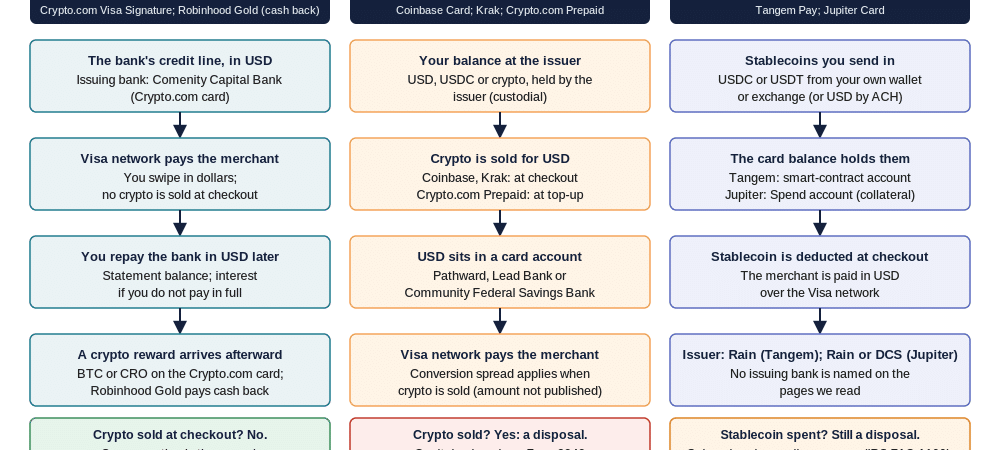
The fastest way to compare a visa crypto card is to ask where the money sits when you tap. The chart below shows the three machines. The table after it fills in the numbers.
Crypto Visa card comparison table (US, checked Nov. 7, 2026; fees re-checked Nov. 19, 2026)
“[n]” is the source number in the Sources list at the bottom. “Not disclosed” means the issuer’s pages and agreement we read do not say. All sources were checked on Nov. 7, 2026, unless the cell says otherwise. Plan prices and listed FX fees were re-checked Nov. 19, 2026.
| Card | Visa type | Issuing bank | What you spend | Rewards | Annual / monthly fee | Foreign transaction (FX) fee | Crypto conversion spread | US availability (excluded) | Credit check |
|---|---|---|---|---|---|---|---|---|---|
| 1. Credit cards on Visa (pay rewards on dollars you spend) | |||||||||
| Crypto.com Visa Signature Credit Card | Credit (Visa Signature) [1] | Comenity Capital Bank [1][2] | USD credit line [1] | BTC or CRO. Basic 1.5% (BTC: first $250 a month, then 1.0%). Plus 3.5%, Pro 4.5%, Private 5.0% to 6.0% (BTC capped at $500 to $10,000 a month, then 2.0%). Above Basic needs a Level Up subscription or CRO lockup [1][3] | Annual fee: none [2]. Level Up Plus $4.99/mo or $49.90/yr; Pro $29.99/mo or $299.90/yr (checked Nov. 19, 2026) [29] | 3.0% of each transaction in USD [2] | None at checkout (you spend dollars). Rewards are credited at the market rate when you buy [1] | States where the Crypto.com App is offered; not New York [4][5] | Yes: soft prequalification, then credit approval [1][4] |
| Robinhood Gold Visa credit card (context: cash back, not crypto) | Credit (Visa Signature) [30] | Coastal Community Bank [6][7] | USD credit line [7] | 3% cash back; not crypto [8] | Annual fee: none with Robinhood Gold membership, which is required [6][8] | 3% if the account opened on or after Jul. 1, 2026; none if opened before [6][7] | Not applicable | Invitation or waitlist; no state list found [8] | Yes: credit approval; the pre-check says no score impact [8] |
| 2. Prepaid and debit Visa cards (spend your crypto or fiat balance) | |||||||||
| Coinbase Card | Prepaid debit (Coinbase’s wording) [9][11] | Pathward, N.A. [9][11] | USD, USDC or crypto in your Coinbase account; crypto is converted to USD at purchase [9] | Optional crypto rewards; rate “variable”, shown in the app; no percentage published [9] | $0 annual; $0 monthly [9][11] | $0 per the fee table in the Oct. 14, 2024 agreement (older than 12 months) [11] | A spread applies when crypto is sold; amount not disclosed [9][10] | All states except Hawaii [9]. Agreement: US citizen or permanent resident [11] | No credit check [9][12] |
| Crypto.com Prepaid Visa | Prepaid [13] | Community Federal Savings Bank [13] | USD held on the card; you top up from crypto, cash, a debit or credit card, or PayPal [13][15] | Varies by tier. The Basic (Midnight) tier earned 0% when we last checked on Oct. 15, 2026; not re-checked today [29] | Monthly fee $0; $4.95 a month inactivity fee after 12 idle months; top-up fee debit card 1%, credit card 2.99%, PayPal 2.1% [13][14] | 3% on Midnight, Ruby, Jade and Indigo; none on Icy, Rose and Obsidian [13][14] | Not disclosed as a percentage; the crypto rate is held for 15 seconds at top-up [15] | States where the App is offered; not New York; not US territories [5] | No [4] |
| Krak Debit Card | Debit [16] | Lead Bank (program manager Stripe) [16] | Krak Everyday balance (cash or crypto); crypto converted to USD when you pay [16] | Cashback by 30-day average balance: 0% under $1,000, 1% from $1,000, 1.5% from $10,000, 1.75% from $75,000, 2% from $150,000; paid in USD or BTC [17][18] | Virtual and plastic card free; replacement $4.99; no monthly or annual card fee listed [18] | Visa exchange rate plus 1% [18] | “Variable spread” on crypto spending; amount not disclosed [18] | Eligible US residents; not New York, Maine, Massachusetts or Indiana [16][18] | Not mentioned; SSN is collected for the ID check [16] |
| 3. Self-custody and Web3 Visa cards (funded from your own wallet; only cards whose live pages we could verify) | |||||||||
| Tangem Pay | “A Visa card”; Tangem’s pages use no single label (debit, credit or prepaid) [20][22] | No bank named. Issued by Rain, a Visa Principal Member; program run by Paera LLC [20] | USDC or USDT you load into your Tangem Pay account; a Tangem Wallet is required [20][22] | 1% (Basic, capped at $100 a month) or 2% (Plus, capped at $300 a month), paid in USDC. The page also says a rewards program is “coming soon” [20] | Basic $0; Plus $29.99 a month (free at $4,500 monthly spend). Bank top-up by ACH $1 (free on Plus) or FedWire $11. ATM 4% (Basic) or 2% (Plus). Dispute fee $30. Network fees on crypto top-ups [20][21] | Visa exchange rate plus 1.5% [21] | Stablecoin deducted 1:1 per Tangem; fee for swapping other tokens not disclosed on the pages we read [22] | “Not all US states are supported”; no state list on the pages we read [20] | No credit line; ID verification [20][22] |
| Jupiter Card (custody model not stated) | “A Visa card”; “credit-card infrastructure”, no credit line [23] | No bank named. Issued by Rain or DCS, assigned by country of residence; the docs we read do not say which serves US residents [23] | USDC or USDT deposited to a Spend account; on Rain-issued cards the deposit stays on-chain as collateral [23] | 2% base cashback; a higher rate is tied to a referral program, which we do not cover [23] | Annual fee none. Physical card $13.13 plus shipping. Deposits from non-Solana networks at least $0.30 plus gas. ATM $1 plus 0.65% [23][24] | 1% on non-USD payments (Rain); 1.8% (DCS) [24] | None stated for USDC; swaps into USDC 0.1% to 0.2% [24] | Not published on the docs pages we read; US applicants are asked for their state [23] | No; identity verification [23] |
Crypto Visa credit card: pays crypto, spends dollars
Is there a Visa credit card that pays crypto?
Yes, in the US the clear example is the Crypto.com Visa Signature Credit Card. Comenity Capital Bank is the issuer, and the bank’s rate and fee summary (printed November 2026) lists no annual fee, a 3.0% foreign transaction fee, and purchase APRs of 17.74%, 25.74% or 31.74% depending on credit. You spend dollars from a credit line, so no crypto is sold when you pay. Rewards arrive afterward in BTC or CRO.
- The rate you actually get depends on a plan. Crypto.com’s help center lists 1.5% on the free Basic plan, rising to 6.0% on the top plan. Every plan above Basic needs a Level Up subscription or a CRO lockup. Crypto.com’s US Level Up page lists Plus at $4.99 a month or $49.90 a year, and Pro at $29.99 a month or $299.90 a year (checked Nov. 19, 2026).
- BTC rewards are capped each month. On Basic the BTC rate is 1.5% on the first $250 a month, then 1.0%. CRO rewards are not capped, but CRO is a different, volatile token.
- Approval is a real credit check. Crypto.com says prequalification uses a soft inquiry that does not affect your score. The full application is subject to credit approval, and the bank’s agreement lets it obtain your credit report. The bank can also close or suspend the account at any time, for any reason, under the agreement.
- Availability: where the Crypto.com App is offered; New York is restricted. The rewards program terms we found (dated Sept. 2, 2025, older than 12 months) also say a New York resident cannot join.
Roundups that mix up the network: Gemini, Coinbase One Card and Robinhood Gold
- Gemini Credit Card: a Mastercard World Elite, issued by WebBank [25]. It is not a Visa.
- Coinbase One Card: a credit card that runs on the American Express network [26]. It is not a Visa, and it is a different product from the Coinbase Card below.
- Robinhood Gold Card: a real Visa credit card from Coastal Community Bank, but it pays 3% cash back, not crypto, and needs a Robinhood Gold membership [6][8]. Its foreign transaction fee changed: 3% if you opened the account on or after Jul. 1, 2026, none before [7]. Details are in our guide to the Robinhood Gold Card foreign transaction fee.
Crypto Visa debit card: prepaid and debit cards that spend your crypto
A crypto visa debit card is really a prepaid or debit card at a bank, linked to an account at a crypto company. The card itself holds US dollars. Your crypto gets sold to make those dollars, and the timing depends on the card.
- Coinbase Card (Pathward). Coinbase calls it a “Visa prepaid debit card.” You can spend dollars, USDC or crypto; crypto is converted to dollars at purchase. Coinbase says there are no Coinbase transaction fees, but a spread applies when it buys or sells crypto, and it does not publish the spread. Rewards are optional, variable and shown in the app. No credit check. Not available in Hawaii. The long-form fee table we could read is dated Oct. 14, 2024, so treat “$0 international transactions” as older than 12 months.
- Crypto.com Prepaid Visa (Community Federal Savings Bank). The agreement says only US dollars are held on the card. Crypto is converted when you top up, and the top-up screen holds the rate for 15 seconds. The foreign fee is 3% on four of the seven tiers. ATM withdrawals are free up to $200 to $1,000 a month by tier, then 2%. Funding from a debit card costs 1%, a credit card 2.99% and PayPal 2.1%.
- Krak Debit Card (Lead Bank). Spends your Krak Everyday balance; crypto is converted to dollars when you pay, with a variable spread. FX is the Visa rate plus 1%. Cashback runs 0% to 2% by 30-day average balance. We cover the tiers in our Krak Card US cashback tiers guide.
The cost you cannot see is the spread. Coinbase and Krak say a spread applies when crypto is sold; Crypto.com does not state one as a percentage. Because none of the three publishes a number, we cannot rank them on the cost of spending crypto. Spending a dollar or stablecoin balance avoids the crypto-sale spread but not every cost, as the tax section below explains.
Self-custody Visa crypto card: stablecoins from your own wallet
A self-custody visa crypto card lets you keep your coins in a wallet you control and move stablecoins onto a card balance when you want to spend. We found two with live US pages. Tangem says Rain, a Visa Principal Member, issues its card; Jupiter uses Rain or DCS. Neither names a bank.
- Tangem Pay needs a Tangem Wallet. You load USDC or USDT, or send dollars by ACH, and the card spends from a smart-contract account that Tangem says you control. Cashback is 1% or 2% in USDC with monthly caps. Costs listed in Tangem’s October 8, 2026 fee schedule include a 1.5% FX markup, a 4% or 2% ATM fee, a $29.99 monthly Plus plan and a $30 dispute fee.
- Jupiter Card takes USDC or USDT on Solana into a Spend account. On Rain-issued cards the docs say deposits stay on-chain as collateral. FX is 1% on Rain-issued cards (1.8% on DCS), and the base cashback is 2%. The docs pages we read do not list supported US states.
Read the label carefully. “Self-custody” describes where your coins sit before you load the card, not how the card is regulated. Tangem’s own pages call it “a Visa card”; one Tangem blog says it is not a debit or credit product, while another Tangem comparison calls it a “Virtual Visa credit card, collateralized by USDC.” Jupiter says the card “uses credit-card infrastructure” and does not issue credit lines. Whether you get credit-card or debit-card fraud protection is not stated in the pages we read.
Do crypto Visa cards charge foreign transaction fees?
Most list one. The table below is arithmetic on each issuer’s own percentage for a $1,000 purchase in a foreign currency. It shows only the card’s listed fee. It does not include Visa’s exchange-rate difference or any crypto conversion spread.
| Card | Listed foreign fee | On a $1,000 foreign purchase |
|---|---|---|
| Crypto.com Visa Signature Credit Card [2] | 3.0% | $30.00 |
| Robinhood Gold, opened on or after Jul. 1, 2026 [7] | 3% | $30.00 (opened before: $0) |
| Crypto.com Prepaid: Midnight, Ruby, Jade, Indigo [14] | 3% | $30.00 (Icy, Rose, Obsidian: $0) |
| Tangem Pay [21] | Visa rate plus 1.5% | $15.00 |
| Krak Debit Card [18] | Visa rate plus 1% | $10.00 |
| Jupiter Card (Rain) [24] | 1% | $10.00 |
| Jupiter Card (DCS) [24] | 1.8% | $18.00 |
| Coinbase Card [11] | $0 (Oct. 14, 2024 agreement) | $0.00 |
Is spending crypto with a Visa card taxable? The dividing line
The tax answer follows the architecture. For US federal tax, the IRS treats digital assets, including stablecoins, as property (IRS FAQ on digital asset transactions, A47 and A48; Notice 2014-21, A-1).
| What you spend | What it means for tax | IRS source |
|---|---|---|
| Dollars on a credit card (Crypto.com Visa Signature) | No crypto is sold at checkout, so the purchase is not a crypto disposal. The reward is a separate question: a rebate or income? The IRS has not ruled on card rewards. Our pillar guide on whether crypto credit card rewards are taxable sets out both views. We do not pick one here. | Notice 2014-21, A-3 and A-4 (crypto received as payment for goods or services is income); no IRS question about card rewards |
| Crypto through a prepaid or debit card (Coinbase, Krak, Crypto.com Prepaid) | Selling crypto for dollars, or paying for goods or services with it, is a disposition with a capital gain or loss. Each purchase can create one. Report on Form 8949 and Schedule D; see our Form 8949 guide. On Crypto.com Prepaid the sale appears to happen at top-up, because the card holds only dollars; that timing is our reading of its agreement, not a Crypto.com statement. | FAQ A49, A62, A64, A65, A109; Notice 2014-21, A-1 |
| Stablecoins (USDC through Coinbase Card, Tangem Pay or Jupiter Card) | Still a disposal. The gain or loss is usually near zero if the coin trades at $1.00, but the IRS says you recognize it and must report it even if no form arrives. Coinbase’s help center says spending USDC at par “should not result in a taxable gain or loss”; that is Coinbase’s view, not an IRS exemption. | FAQ A47, A100, A108 |
| A dollar balance on a prepaid or debit card | No crypto is sold, so no crypto disposal. Krak says so for USD-only funding. | FAQ A49 applies only if crypto is sold |
Is there a small-purchase exception, or a stablecoin exception?
- No small-purchase exemption today. The IRS FAQ has none. Krak’s tax page says there is “no US federal de minimis exemption for personal crypto purchases.”
- Stablecoin relief is only proposed. The Senate ADAPT Act (S. 5616) would add a section 1034 so a covered payment stablecoin used to buy goods or services creates no gain or loss, after Dec. 31, 2026, with conditions on issuer and price. The PARITY Act and H.R. 10357 have similar ideas. RSM said on Oct. 30, 2026: “None of these rules is law today, and none supports a current return position.” Congress.gov shows H.R. 10357 (Digital Asset Tax Certainty Act) introduced Sept. 14, 2026 and ordered reported by Ways and Means, 38-5, on Sept. 16, 2026; S. 5616 (ADAPT Act) was introduced Sept. 30, 2026 and referred to Senate Finance. Neither has passed either chamber as of Nov. 8, 2026.
- The GENIUS Act did not settle it. The GENIUS Act (P.L. 119-27) became law in July 2025. Bloomberg Tax commentary says neither the Act nor the Clarity Act draft addresses how payment stablecoins are taxed, and the Tax Adviser (Aug. 31, 2026) cites the Act only for a definition used in a pending bill. We did not read the Act itself and found no IRS notice that changes stablecoin tax treatment.
- Your broker’s 1099-DA may not catch every spend. The 2026 Form 1099-DA instructions let a broker skip designated sales of qualifying stablecoins when a customer’s total for the year is $10,000 or less, but the IRS says you still report the gain or loss. We could not confirm whether Coinbase’s or Crypto.com’s 1099-DA includes card spending. Crypto.com’s tax-forms page does not say; see our Crypto.com tax forms guide.
Credit vs debit fraud rules: one line
Credit cards fall under Regulation Z, which caps your liability for unauthorized use at $50, and debit and prepaid accounts fall under Regulation E rules, including the CFPB’s prepaid-account rule; we could not find equivalent liability terms for Tangem Pay or Jupiter Card, so read their agreements first and see our guide on whether crypto credit cards are safe.
What people said on Reddit in 2026 (anecdotes)
We read 8 public threads from r/Coinbase, r/CryptoCurrency and r/Crypto_com through search excerpts. That is a small sample, not a poll. Reddit’s feeds were not available to our tool, so we saw only what the excerpt showed. Vendor staff post in these threads; we do not count their comments as user reports. We paraphrase and quote no one. The r/Crypto_com threads about US prepaid fees that we found were from 2021 and 2022, so we left them out.
| What people asked or said | When | What it tells you |
|---|---|---|
| Buying crypto with USDC on Coinbase’s regular buy flow adds about 1% of spread compared with a card or cash. (About buying, not Card spending.) | Feb. 9, 2026 | A “stablecoin” is not always free at the point you acquire it. |
| Recurring buys always came in above the chart price. Reply: you buy at the ask, you read the midpoint. | Feb. 2, 2026 | Spread complaints are common. |
| “Why are fees so high?” One commenter said a BTC order executed “almost $1k” worse than quoted (one unverified anecdote). | Mar. 13, 2026 | The spread is the cost people notice. |
| A user bought XRP at 1.33 and the receipt said 1.36; replies pointed to the spread. | Mar. 27, 2026 | Same point. |
| Coinbase One Card: after returning an item, a user got $99 of bitcoin back instead of the $122.09 reward they expected. One reply: only use it when you will not return anything. | Aug. 5, 2026 | Crypto rewards on a credit card can be reversed at a different price. |
| Coinbase One Card declined with no reason; the user said support blamed an Amex security block. | Apr. 20, 2026 | Declines happen on credit cards too. |
| A user in Australia said the Crypto.com card’s cashback keeps changing and fees are not clear. | About June 2026 (date not shown) | Reward rules at Crypto.com change often. (Non-US user.) |
| A thread on Level Up benefit changes quoted a notice cutting one prepaid tier’s CRO reward to 1.5%. | About late July 2026 (date not shown) | Not verified on a Crypto.com page. |
What we left out, and why
- Oobit. Oobit’s FAQ says the app is available in all 50 US states. Its own card terms (effective Aug. 1, 2025, older than 12 months) name ThirdNational as issuer and include the line “You attest that you are not a United States citizen” and that the card is “intended for those outside of the United States” [27][28]. The issuer’s pages conflict, so we left it out of the US table. We did not verify any card that does not appear in this guide, and not appearing is not a judgment on it.
- Cards we did not check this round: Fold, Uphold, KAST and ether.fi Cash, among others. They may fit the architectures above; we have not read their live pages for this guide.
What we could not confirm
- The size of the crypto conversion spread at Coinbase, Krak and Crypto.com. None publishes a percentage.
- Whether Coinbase’s international fee is still $0: the only fee table we read is dated Oct. 14, 2024.
- Whether Coinbase’s, Crypto.com’s or Krak’s Form 1099-DA includes card spending.
- Tangem Pay: the excluded US states, the issuing bank, whether the card is credit, debit or prepaid, which fraud rules apply, and the price of the required Tangem Wallet.
- Jupiter Card: whether the card account is self-custody, the monthly cap on base cashback, and the exact issuer for a US resident (Rain or DCS; not stated), and which US states are supported.
- Crypto.com credit card: any state exclusions beyond New York for the rewards program.
- Crypto.com Prepaid: the Basic tier’s rewards today (last checked Oct. 15, 2026).
FAQ
Is there a Visa credit card that pays crypto?
Yes. The Crypto.com Visa Signature Credit Card, issued by Comenity Capital Bank, pays BTC or CRO on dollar purchases. The free Basic plan pays 1.5% (BTC on the first $250 a month, then 1.0%). It has no annual fee, a 3.0% foreign transaction fee and a credit check, and it is not offered in New York. Robinhood’s Gold Card is also a Visa credit card but pays cash back, not crypto.
Is spending crypto with a Visa card taxable?
Yes, in the US, if the card sells crypto or stablecoins to pay. The IRS treats crypto as property, so a spend is a disposal and can create a capital gain or loss, reported on Form 8949. Spending dollars on a credit card is not a crypto sale; the crypto reward is a separate, unsettled question. Proposed relief for stablecoin spending is not law. This is not tax advice.
Do crypto Visa cards charge foreign transaction fees?
Many do. The Crypto.com credit card charges 3.0%. Crypto.com Prepaid charges 3% on four of seven tiers. Krak adds 1% to the Visa rate, Tangem Pay 1.5%, and Jupiter Card 1% on Rain-issued cards and 1.8% on DCS. Coinbase’s agreement from October 2024 lists $0, and Robinhood Gold charges 3% on accounts opened on or after July 1, 2026. These are listed card fees only.
Which crypto Visa cards work in the US?
From the cards we verified: the Crypto.com Visa Signature Credit Card and Crypto.com Prepaid (not New York), Coinbase Card (not Hawaii), Krak Debit Card (not New York, Maine, Massachusetts or Indiana), Jupiter Card (state list not published on its docs) and Tangem Pay (some states only; no list published). Gemini’s card is a Mastercard and the Coinbase One Card runs on Amex.
Do I need crypto to get one?
Usually not. The Crypto.com credit card’s Basic plan needs no stake or subscription, but you need a Crypto.com App account and credit approval. Coinbase Card says there is no credit check or requirement to stake, and it spends dollars. Krak and Crypto.com Prepaid can be funded with dollars. Tangem Pay needs a Tangem Wallet and stablecoins or dollars by bank transfer. Rewards above Basic on the Crypto.com credit card need a subscription or CRO lockup.
Are self-custody crypto cards safe?
We cannot say, and the pages we read do not settle it. Your coins stay in your wallet until you load the card, Tangem says the card balance sits in a smart-contract account you control, but spending runs through a card program whose issuer is not named as a bank, and the fraud and dispute rules were not stated in the pages we read. Krak says its balances are not FDIC-insured; the Coinbase and Crypto.com prepaid agreements describe FDIC insurance eligibility for the dollars on the card, subject to conditions. We found no FDIC wording on the Tangem or Jupiter pages. Read the agreement before you load more than you can afford to lose.
Sources
Checked Nov. 7, 2026, unless noted. Crypto.com Level Up prices, Robinhood FX, Tangem fee schedule and Jupiter fees re-checked Nov. 19, 2026. Plain links; no affiliate, referral or tracking codes.
- Crypto.com Visa Signature Credit Card page: crypto.com/us/cards
- Comenity Capital Bank, Crypto.com Visa Signature credit card agreement and rate and fee summary (printed Nov. 2026): d.comenity.net/legaldocs/cryptocom/legal-documents/cca
- Crypto.com help, credit card BTC rewards: help.crypto.com/en/articles/15112463
- Crypto.com help, how to apply (credit check, availability): help.crypto.com/en/articles/11502058
- Crypto.com help, US states: help.crypto.com/en/articles/2692288
- Robinhood Gold Visa rates and fees (updated Jul. 1, 2026): api.robinhood.com/creditcard/legal/interest-fees
- Robinhood Gold Card FAQ: robinhood.com/us/en/support/articles/robinhood-gold-card-faq
- Robinhood Gold Card page: robinhood.com/creditcard
- Coinbase Card page: coinbase.com/card
- Coinbase help, Coinbase Card fees and taxes: help.coinbase.com/…/cb-card-fees-tax
- Pathward cardholder agreement for the Coinbase Card, dated Oct. 14, 2024 (older than 12 months): Coinbase_CHA_October_14_2024.pdf
- Coinbase help, debit card overview: help.coinbase.com/…/cb-card
- Crypto.com Prepaid Visa Cardholder Agreement (effective Sept. 1, 2026): crypto.com/document/us_card
- Crypto.com help, Prepaid Visa fees and limits (US): help.crypto.com/en/articles/5966563
- Crypto.com help, funding the Prepaid Visa (US): help.crypto.com/en/articles/3131878
- Krak, getting started with the US debit card: support.krak.app/articles/getting-started-with-us-krak-card
- Krak, US cashback overview: support.krak.app/articles/us-krak-card-cashback-overview
- Krak, pricing: krak.app/pricing
- Krak, US card tax information: support.krak.app/articles/us-krak-card-tax
- Tangem Pay page: tangem.com/en/tangem-pay
- Tangem Pay terms, fees and limits (Oct. 8, 2026): tangem.com/docs/en/tangem-visa-tariffs.pdf
- Tangem, “Is Tangem Pay a credit card or a debit card?” (Jun. 30, 2026): tangem.com/en/blog/post/tangem-pay-credit-card-or-debit
- Jupiter Card docs: docs.jup.ag/user-docs/global/spend/jupiter-card
- Jupiter fees and limits: docs.jup.ag/user-docs/global/spend/fees-and-limits
- Gemini Credit Card page: gemini.com/credit-card
- Coinbase One Card overview: help.coinbase.com/en/creditcard/overview
- Oobit card terms (effective Aug. 1, 2025, older than 12 months): oobit.com/legal/card-terms
- Oobit FAQ: oobit.com/faq
- Crypto.com Level Up page (Plus and Pro prices re-checked Nov. 19, 2026; prepaid rewards last checked Oct. 15, 2026): crypto.com/us/levelup
- Robinhood Gold Card Visa benefits: robinhood.com/us/en/support/articles/robinhood-gold-card-visa-benefits
- IRS: FAQ on digital asset transactions; Notice 2014-21; Instructions for Form 1099-DA (2026).
- Pending bills and commentary (secondary): RSM, Oct. 30, 2026; The Tax Adviser, Aug. 31, 2026; Bloomberg Tax (date not shown in our excerpt).
- Fraud liability: Regulation Z, special credit card provisions (Federal Reserve text); CFPB prepaid account rule announcement.
- Reddit threads (anecdotes): r/Coinbase Feb. 9, 2026, Feb. 2, 2026, Mar. 13, 2026, Mar. 27, 2026, Aug. 5, 2026, Apr. 20, 2026; r/CryptoCurrency about June 2026; r/Crypto_com about late July 2026.
Disclaimer
This article is educational and is not financial, legal or tax advice. Card terms, state lists and tax rules change; the information here was checked on Nov. 7, 2026, with fees and plan prices re-checked Nov. 19, 2026, and may be out of date when you read it. Pending legislation is not law. Tax treatment depends on your facts, so talk to a qualified tax professional before you spend crypto or file. CryptoCashbackCard is not affiliated with any card issuer, bank or exchange named. We did not test any card or account. This page has no affiliate or referral links. Author: CryptoCashbackCard.