
Crypto credit cards pay rewards in bitcoin, XRP, CRO and other coins instead of cash. Is that income? The IRS has never issued guidance written specifically for crypto card rewards. Under general tax rules, rewards you earn by spending are commonly treated as a discount on what you bought, not as income. What happens later, when you sell or spend the crypto, is a different matter. Here are the current rules, the gray areas, and what H.R. 10357 would change.
This page is general information, not tax advice. Tax treatment depends on your facts, so consult a qualified tax professional before filing. CryptoCashbackCard is an independent site, not affiliated with any card issuer.
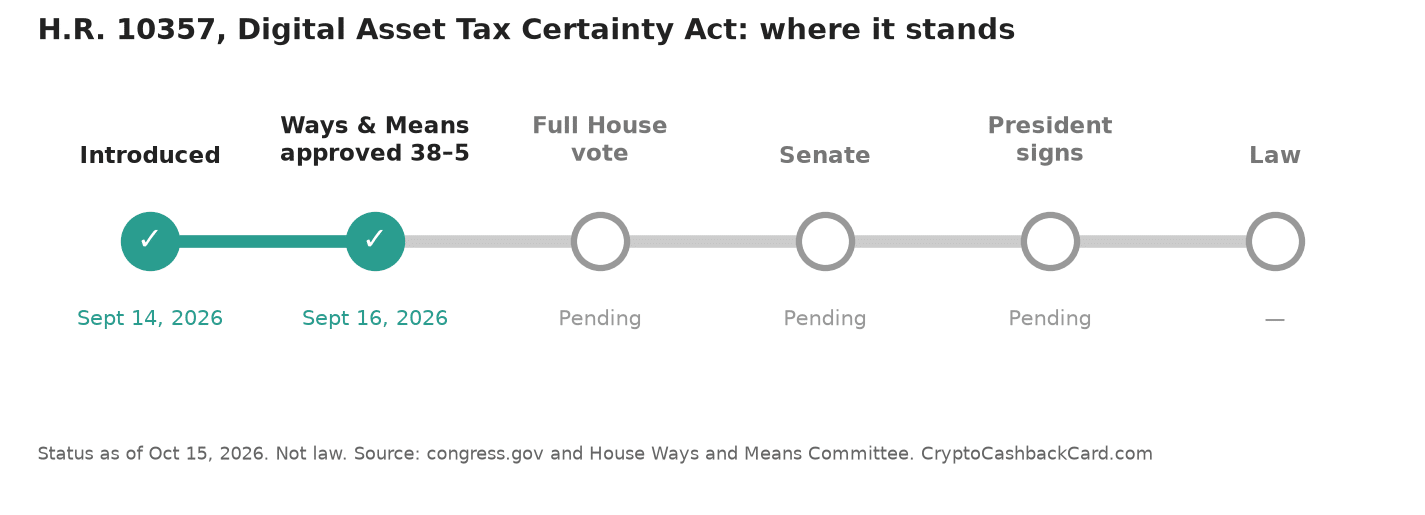
Latest update (Oct 15, 2026): H.R. 10357, the Digital Asset Tax Certainty Act, was introduced in the House on Sept. 14, 2026. On Sept. 16, 2026, the House Ways and Means Committee voted 38–5 to report it, as amended, to the full House. It is not law. It still needs House and Senate passage and the President’s signature. Nothing in this bill changes the rules for your 2025 or 2026 return today. We will update this box as the bill moves.
The short answer
- Rewards earned by spending: commonly treated as a rebate, or a reduction in the price of your purchases, rather than taxable income. The IRS has not confirmed this for crypto card rewards specifically.
- Bonuses that don’t require spending (for example, cash for opening an account or referring a friend) may be treated as income and reported to you on a tax form.
- Selling, trading or spending the crypto later is a taxable event under current IRS rules. You may have a capital gain or loss.
What the IRS has and hasn’t said
The IRS treats digital assets as property, not currency (IRS: Digital assets). General property tax rules apply to crypto transactions (IRS virtual currency FAQ, Q2).
What the IRS has not done is publish a ruling, notice or FAQ that addresses credit card rewards paid in crypto. Any answer is an application of general principles.
The closest general principle is the rebate rule. IRS Publication 525 says a cash rebate “you receive from a dealer or manufacturer of an item you buy isn’t income, but you must reduce your basis by the amount of the rebate” (IRS Publication 525). Card rewards earned on purchases are widely treated the same way: as a discount on what you bought. That view rests on analogy, not a crypto-specific IRS rule.
By contrast, the IRS has been clear that some other crypto receipts are income. Crypto received for services is ordinary income at fair market value (FAQ Q9 and Q12). Staking rewards are included in gross income when you gain “dominion and control” over them (Rev. Rul. 2023-14). Card rewards differ because you made a purchase to earn them, but that contrast is why the rebate view is not settled.
Sign-up and referral bonuses can be different
A bonus you get without spending, such as for opening an account or referring someone, has no purchase price to reduce. Bonuses like these may be taxable, and some companies report them on Form 1099-MISC. For comparison, the IRS says gifts for opening a bank account “may be reported to you as interest income on Form 1099-INT” (IRS Publication 550). If you receive a 1099 for a bonus, don’t ignore it; ask a tax professional how to report it.
Your cost basis, and when tax shows up
Even if the reward itself isn’t income, the crypto you receive becomes property you own. Two numbers matter:
- Basis. Your basis is generally what you paid, in U.S. dollars (IRS: Digital assets). For card rewards, the IRS hasn’t said what the basis should be. A common approach is to use the fair market value on the day the reward was credited. Some argue for a basis of zero. Ask your tax professional which approach fits your situation, and use it consistently.
- Gain or loss when you dispose of it. When you sell crypto for dollars, trade it for another coin or spend it on goods, the IRS says you recognize a capital gain or loss (FAQ Q4, Q14 and Q16). The gain or loss is the difference between what you got and your basis. Held one year or less, it’s short-term; more than one year, long-term (FAQ Q6).
Simple example: you earn $20 of bitcoin in rewards. Months later you sell it for $30. Using a fair-market-value basis, you would have a $10 short-term capital gain. If you’d sold it for $15, you would have a $5 loss.
Form 1099-DA: new broker reporting
Starting with transactions on or after Jan. 1, 2025, crypto brokers must report gross proceeds of sales to the IRS on Form 1099-DA. Brokers must also report basis on certain transactions on or after Jan. 1, 2026 (IRS: Digital assets, broker compliance; About Form 1099-DA).
For cardholders, that means if you sell reward crypto on a custodial platform, you may receive a 1099-DA, and the IRS gets a copy. The form may not show the basis for reward crypto, so your own records matter. Also note: the IRS says you must report taxable crypto transactions “regardless of the amount or whether you receive a payee statement” (FAQ Q42). If you use Coinbase, see which tax forms Coinbase sends and where to download them.
How to keep records
The IRS says to keep records of your receipt, sale, exchange or other disposition of digital assets and their fair market value in U.S. dollars (IRS: Digital assets; FAQ Q46). For card rewards, a practical list:
- Download your rewards history from the card app at least once a year: date, coin, amount and dollar value when credited.
- Save records of every sale, swap or transfer, including dates and dollar values.
- Note any transfers between your own wallets. The IRS says moving crypto between accounts you own isn’t taxable (FAQ Q38), but you’ll need records to show it.
- Keep any 1099-MISC, 1099-INT or 1099-DA you receive.
Examples by card
The tax principles are the same for every issuer; what differs is the coin. Reward options change, so check current terms.
| Card | Rewards paid in (per issuer) | Tax point to watch |
|---|---|---|
| Gemini Credit Card | Crypto; editions include Bitcoin, XRP and Solana | Each coin you hold has its own basis and holding period |
| Coinbase One Card | Bitcoin | Selling or spending the bitcoin later is a disposition |
| Crypto.com Visa Signature Credit Card | BTC or CRO (your choice) | Same rules apply to CRO as to bitcoin |
Sources: Gemini Credit Card, Coinbase card, Crypto.com cards. Curious why a Gemini purchase paid 1% instead of 4%? See which stores cardholders report earning just 1%, and why. For approval data, see the median starting limit from 33 cardholder reports.
Comparing cards before you apply? See how the main crypto cashback cards compare on rates and fees.
What H.R. 10357 would change for cardholders
Here are the provisions most relevant to people earning crypto rewards, as amended in committee (the amendment in the nature of a substitute adopted Sept. 16, 2026), with the Ways and Means one-pager. For these provisions, the committee version matches the introduced text, except that dates tied to “the introduction of this Act” now read Sept. 14, 2026. The full House or Senate could still change them. Notably, the bill does not add a rule specifically for credit card rewards.
- Small fee exclusion (Sec. 101). “No gain or loss shall be recognized on the disposition of a digital asset in payment of” a de minimis network fee or transaction fee, with each capped at $10. This covers fees paid in crypto, such as network and trading fees. It is not an exemption for small purchases made with crypto. It would apply to dispositions after Dec. 31, 2027.
- Simplified accounting election (Sec. 102). Taxpayers could elect a simplified method for “widely traded digital assets,” which generally works out gain or loss for the year using year-end market values instead of tracking each lot. It would apply to tax years beginning after Dec. 31, 2027.
- Stablecoin gains (Sec. 103). The one-pager describes this as “excluding gain or loss on sales of regulated U.S. dollar stablecoins.” It would apply to tax years beginning after Dec. 31, 2026.
- Wash-sale rule (Sec. 301). The bill would apply the wash-sale rule, which today covers “stock or securities,” to digital assets. Selling crypto at a loss and quickly buying it back would no longer give you a deductible loss. As amended in committee, it would apply to dispositions after Sept. 14, 2026.
Tax attorney and CPA Mark J. Kohler discussed the bill in a public video on Oct 10, 2026. For the actual rules, rely on the bill text and IRS guidance linked here.
FAQ
Is credit card rewards taxable?
Rewards earned by spending are generally treated as a rebate on purchases, not income (see IRS Publication 525 on cash rebates). Bonuses that don’t require spending may be taxable.
Do you pay taxes on cash back rewards?
Usually not, when the cash back is earned on purchases. It’s commonly treated as a reduction in what you paid. Bonuses for opening an account or referrals can be different and may arrive with a 1099.
Are crypto rewards taxable?
It depends on the source. The IRS says staking rewards are income (Rev. Rul. 2023-14), and crypto received for services is income. Crypto card rewards earned by spending are commonly treated as a rebate, though the IRS hasn’t issued specific guidance. Selling or spending the crypto later can create a taxable gain or loss.
How do you report crypto rewards on taxes?
If you sold, traded or spent reward crypto, report the gain or loss on Form 8949 and Schedule D, per the IRS FAQ (Q43). Answer the digital assets question on Form 1040 accurately; the IRS lists receiving digital assets “as a reward” as a “Yes” trigger. For box-by-box steps when your 1099-DA has no cost basis, see our Form 8949 guide for crypto.
Are bitcoin credit card rewards taxable?
The same rules apply to bitcoin as to other crypto. Bitcoin earned on purchases is commonly treated as a rebate when received. If the price rises and you later sell or spend it, the difference is generally a capital gain.
Sources
- IRS: Digital assets
- IRS: Frequently asked questions on virtual currency transactions
- IRS: Internal Revenue Bulletin 2023-33 (Rev. Rul. 2023-14, staking rewards)
- IRS Publication 525: Taxable and Nontaxable Income
- IRS Publication 550: Investment Income and Expenses
- IRS: About Form 1099-DA
- H.R. 10357 amendment in the nature of a substitute (committee version, Sept. 16, 2026)
- H.R. 10357, Digital Asset Tax Certainty Act (bill text as introduced)
- Ways and Means: H.R. 10357 one-pager
- Ways and Means: committee vote record, Sept. 16, 2026
- Congress.gov: H.R. 10357
- Issuer pages: Gemini, Coinbase, Crypto.com
Crypto tax guides
- Coinbase taxes: forms, reports and how to file
- Crypto tax Form 8949 guide (1099-DA with no cost basis)
Read next
Coinbase taxes: forms and how to file
Which forms Coinbase sends, what changes between tax years 2025 and 2026, and how the numbers land on Form 8949.
Which merchants earn 4% on Gemini
Why some gas stations and grocery stores pay only 1%, based on what cardholders report.
Which box to check and what to enter when your 1099-DA has no cost basis.
Disclaimer
This page is general educational information, not tax, legal or financial advice. Tax rules depend on your individual facts and can change. The IRS has not issued guidance specific to crypto credit card rewards, and the treatment described here may not apply to you. Consult a qualified tax professional before making decisions or filing a return. H.R. 10357 is pending legislation and is not law; its provisions may change or never take effect. CryptoCashbackCard is an independent site, not affiliated with or endorsed by Gemini, Coinbase, Crypto.com or any card issuer. This page has no affiliate or referral links.
Spot an error or have a concern about this page? Email us at hello@cryptocashbackcard.com and we will review it promptly.