
Yes, Coinbase reports to the IRS. For US customers, Coinbase sends the IRS (and you) Form 1099-DA for crypto you sold or exchanged, and Form 1099-MISC for rewards and staking income above a set amount. What it reports is not the same as what you owe. This guide explains which form shows what, what is taxable, where to download your Coinbase tax report, and how the numbers end up on Form 8949.
This page is general information, not tax advice. Tax treatment depends on your facts, so consult a qualified tax professional before filing. CryptoCashbackCard is an independent site, not affiliated with Coinbase. This page has no affiliate or referral links.
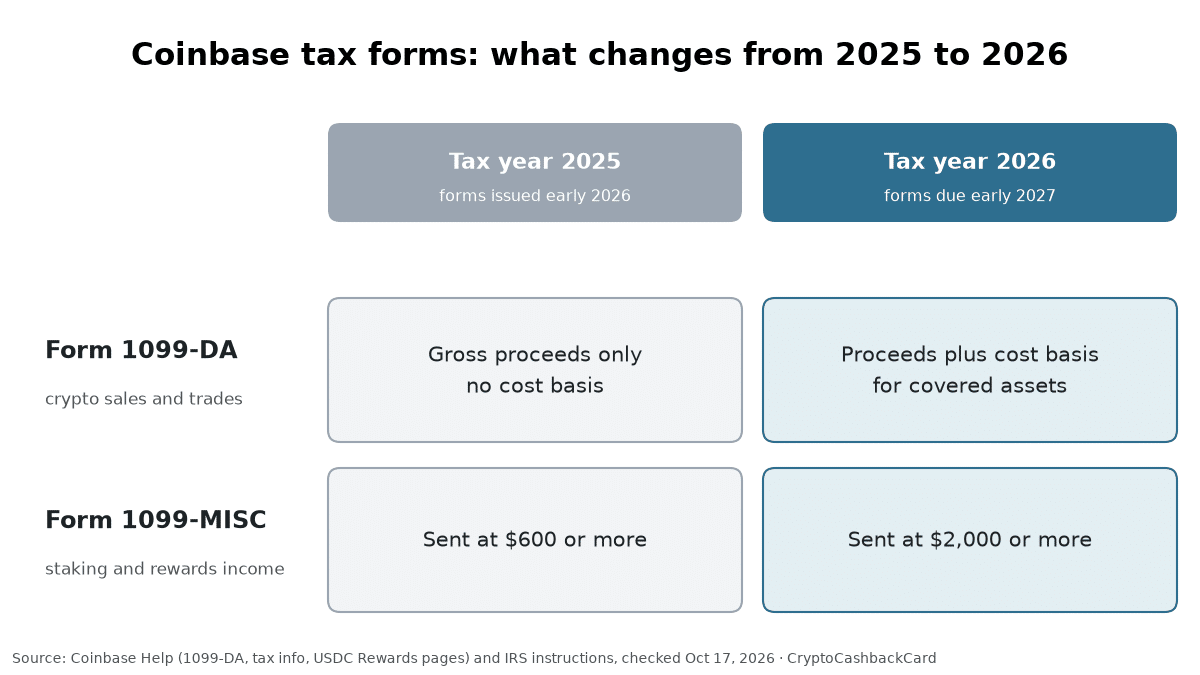
Last updated Oct. 17, 2026. Which tax year is this? Two years matter right now. Tax year 2025 (forms Coinbase issued in early 2026): the first 1099-DA, with sale proceeds only. Tax year 2026 (forms due in early 2027): the 1099-DA adds cost basis for some assets, and the 1099-MISC threshold goes up. We label each rule by year below.
The short answer
- Sold, traded or converted crypto on Coinbase? Expect a Form 1099-DA showing gross proceeds. That is what you received, not your profit.
- Earned staking, Learning rewards or USDC Rewards? That is income. Coinbase sends a 1099-MISC if it reaches the threshold ($600 for 2025, $2,000 for 2026 and later). Under the threshold it is still taxable.
- Got no form? You still have to report. The IRS says you must report taxable crypto transactions “regardless of the amount or whether you receive a payee statement or information return.”
- Coinbase One Card bitcoin back? Coinbase calls spending rewards a rebate, not income at receipt. Selling the bitcoin later is a sale. More below.
Coinbase tax information at a glance: which forms Coinbase sends
| Form | What it covers | Who gets it |
|---|---|---|
| 1099-DA | Gross proceeds from sales and exchanges of crypto (including crypto-to-crypto trades). Cost basis for some assets from tax year 2026. | US customers with reportable sales or exchanges |
| 1099-MISC | Crypto and other income such as staking rewards, Learning rewards and USDC Rewards | US customers who reach the threshold: $600 (tax year 2025), $2,000 (2026 and later) |
| 1099-B | Futures, securities and other financial instruments | US customers who traded those |
| 1099-DIV | Dividends or capital gain distributions over $10 | US customers with those investments |
| 1099-K | Not issued by Coinbase | – |
| Form 8949 | Not provided by Coinbase from tax year 2025 onward (Coinbase points to a CoinTracker plan) | – |
Sources: Coinbase Help: Taxes for US customers, Coinbase Help: tax forms, Coinbase Help: Form 8949. The $2,000 figure matches the IRS: for tax years beginning after 2025 the minimum reporting threshold for certain payments rose to $2,000 (IRS instructions for Forms 1099-MISC and 1099-NEC).
Form 1099-DA: what it shows, and what it does not
The IRS requires brokers to report digital asset sales on Form 1099-DA beginning with transactions on or after Jan. 1, 2025 (IRS: Digital assets). Coinbase’s rules for what lands on it:
- A “sale” includes crypto-to-crypto swaps (bitcoin for ether), crypto-to-dollars, and any trade where you receive an amount for an asset. Small trades count too.
- Gross proceeds are not profit. The form adds up what you received. Your gain or loss is proceeds minus your cost basis.
- Sending crypto to another wallet is not reported as a sale. If you pay a network fee in crypto, only the part used for the fee is reported.
- Time zone: Coinbase uses Eastern Time. A trade just after midnight ET on Jan. 1, 2026 goes on the 2026 form, not 2025.
Source: Coinbase Help: IRS Form 1099-DA.
Cost basis: tax year 2025 vs 2026
- Tax year 2025: the 1099-DA shows proceeds only. Cost basis is blank. You fill it in from your own records.
- Tax year 2026: Coinbase must report basis for covered assets: crypto acquired on or after Jan. 1, 2026 and held at Coinbase until sold.
- Noncovered assets stay your job: anything bought before 2026, and everything you transferred in from another exchange or wallet, whatever the date. The form shows a blank basis with the “noncovered” box checked.
- Which coins you sold: Coinbase lets you choose FIFO, HIFO or LIFO in Coinbase Taxes settings or on the order preview screen. A change applies only to open and future trades, not past ones, so check which method is selected before you sell. For 2025 and 2026, the IRS also lets you record which units you are selling in your own records before the sale (Notice 2025-7, extended by Notice 2026-20). Ask a tax professional before switching methods.
Why this matters: for crypto received from outside Coinbase, Coinbase Taxes estimates basis at $0, because “the IRS may assume a $0 cost basis if you don’t report cost basis.” Leave it blank and you can overstate your gain. Coinbase lets you add original purchase date and cost in Coinbase Taxes. Its receipt date is only a placeholder, so use your real purchase date to decide short-term or long-term (Coinbase Help: edit transaction details).
What is taxable on Coinbase
| Activity | How it is treated | Where it shows up |
|---|---|---|
| Sell crypto for dollars | Capital gain or loss | 1099-DA (proceeds), your Form 8949 |
| Trade one crypto for another | Capital gain or loss on the crypto you gave up | 1099-DA (proceeds), your Form 8949 |
| Staking, Learning rewards, USDC Rewards | Ordinary income at the dollar value when received | 1099-MISC if over the threshold; Schedule 1 |
| Send crypto to your own wallet | Not a sale (Coinbase treats it as still owned). Keep records. | Not on 1099-DA, except crypto used for a network fee |
| DEX trades and Coinbase Wallet activity | Still taxable. Not on Coinbase forms. | Your own records |
| Sell or spend reward bitcoin later | Capital gain or loss versus your basis | 1099-DA (proceeds), your Form 8949 |
Sources: IRS FAQs on digital asset transactions (Q49 sales, Q52 gain or loss), Rev. Rul. 2023-14 (staking), and the Coinbase Help pages above. The IRS instructions for Form 1099-DA say brokers do not report rewards and staking payments on that form, which is why those come on the 1099-MISC (Instructions for Form 1099-DA).
Coinbase One Card rewards: are they taxable?
Coinbase’s own help page says: “Coinbase One Card rewards are not taxable at the time of receipt, as they’re considered rebates, like traditional cashback or points. However, if the Bitcoin rewards increase in value, the appreciated amount is taxable when sold or disposed of” (Coinbase Help: Coinbase One Card benefits and rewards).
That is Coinbase’s position, not an IRS ruling. As of our last check, the IRS has not published guidance written for crypto card rewards. For the general rebate idea and the gray areas, see our guide: Are crypto credit card rewards taxable?
Coinbase treats its different reward programs differently, so do not assume one rule fits all:
| Program | What Coinbase says |
|---|---|
| Coinbase One Card bitcoin back (credit card, earned by spending) | Rebate, not taxable when received. Gain or loss when sold. |
| Coinbase One Card sign-up bonus (for example, a past offer of $50 in bitcoin after $100 of spending; offers change) | Offer terms say the bitcoin “may be taxable income” and Coinbase “may be required to report such amounts on your Form 1099-MISC.” |
| USDC Rewards (paid weekly in bitcoin, or in USDC if you switch) | Ordinary income at fair market value when paid, whether you hold or sell. 1099-MISC if over the threshold. |
| Coinbase Card (the separate debit card) | Spending crypto with it is treated as selling crypto: a taxable transaction. Coinbase says spending USDC while it trades at par with the dollar should not create a gain or loss, and spending your USD balance is not a crypto sale. |
Sources: Coinbase One Card sign-up incentive terms, Coinbase Help: USDC Rewards, tax reporting, Coinbase Help: Coinbase Card (debit) fees and taxes.
What to do with card rewards
- In the Coinbase app, open the Credit card tab, go to Rewards, then See payouts. Save that list each year.
- Note the date, bitcoin amount and dollar value for each payout. You will want it when you sell.
- When you sell reward bitcoin, the sale is a reportable sale like any other and appears on your 1099-DA.
- Check what basis Coinbase Taxes shows for your reward bitcoin and compare it with your payout list. Ask your tax professional how to treat any difference.
- Comparing cards? See our best crypto cashback cards page.
Coinbase tax report: where to download it
- Sign in on the web and go to Coinbase Taxes.
- Select Documents and download your IRS forms (1099-DA, and 1099-MISC if you got one).
- For your own calculations, use View Documents and generate the gain/loss report under Custom Reports. The raw transaction report lists the basis of every transaction without the gain or loss.
- In the Settings tab, choose paperless delivery or mail for future forms.
Good to know:
- The gain/loss and transaction reports are Coinbase-made helpers, not IRS forms.
- Coinbase Taxes covers Coinbase.com only. Coinbase Wallet and Coinbase Pro activity are not included (Coinbase Pro closed in December 2023), and neither are other exchanges.
- Timing: for tax year 2025, Coinbase said the 1099-MISC would arrive by mid-February 2026 and the 1099-DA no later than March 17, 2026, with an email when ready. We could not find a delivery date for tax year 2026 forms.
- If your name, SSN or state is wrong, contact Coinbase support. Coinbase says it can issue a corrected 1099-DA only for a change in state residency, not for other address changes.
- The 1099-MISC amount can differ from “MISC income” shown in the Tax Center. Coinbase says to use the number on the form.
Sources: Coinbase Help: download your tax reports, Coinbase Learn: tax forms explained.
How to file: Form 8949 basics
Form 8949 lists each sale so you and the IRS can match what Coinbase reported. Form 8949 then feeds Schedule D. Ordinary income such as staking goes on Form 1040 or Schedule 1 (IRS FAQ Q109 and Q110). Coinbase no longer produces Form 8949 from tax year 2025, so you need tax software, a preparer, or the IRS form filled in by hand. Our Form 8949 guide for a 1099-DA with no cost basis walks through the boxes line by line.
A beginner walkthrough for a 1099-DA with a blank basis (the normal case for tax year 2025):
- Pick the short-term or long-term part. One year or less is short-term (Part I). More than one year is long-term (Part II). The holding period starts the day after you acquired the asset (IRS FAQ Q50).
- Check the right box. The IRS says digital asset transactions use boxes G, H or I for short-term and J, K or L for long-term, and not boxes C or F. A 1099-DA with no basis reported to the IRS goes in box H (short-term) or box K (long-term). Box G or J is for forms that show basis reported to the IRS. If you got no 1099-DA for a sale (for example, a DEX trade or a sale from your own wallet), use box I (short-term) or box L (long-term).
- Column (d), proceeds: enter the proceeds shown on the 1099-DA.
- Column (e), cost or other basis: enter your actual basis from your records. Coinbase says US trading fees are already included in basis and subtracted from proceeds.
- Column (h): gain or loss is proceeds minus basis. Totals go to Schedule D.
- Answer the digital assets question on Form 1040. You answer “Yes” if you sold or exchanged digital assets, or received them as a reward, award or payment.
Illustration only (made-up numbers): you bought $1,000 of bitcoin on Coinbase in 2024 and sold it for $1,500 in 2025. Your 1099-DA shows $1,500 proceeds and no basis. On Form 8949 you enter $1,500 in column (d) and $1,000 in column (e). Your gain is $500, long-term because you held it more than a year. If you left basis blank, the form would imply a $1,500 gain.
A shortcut for later years: the IRS says that if your 1099-DA shows basis was reported to the IRS, shows no adjustments, and you need no corrections, you may skip Form 8949 and enter totals directly on Schedule D (the IRS calls this “Exception 1”). With most 2025 forms showing no basis, this will matter mostly from tax year 2026. Sources: Instructions for Form 8949.
Common Coinbase tax mistakes
- Treating gross proceeds as profit. Reporting $20,000 of proceeds as gain when you paid $19,000 overstates your tax.
- Skipping a sale because no form arrived. A missing form does not make a sale tax-free (IRS FAQ Q108).
- Ignoring activity outside Coinbase. DEX trades, Coinbase Wallet and other exchanges are not on Coinbase’s forms.
- Leaving basis blank on transferred-in crypto. Coinbase may show $0 basis. Add your real purchase date and cost.
- Skipping small rewards. Rewards under the 1099-MISC threshold are still income. The threshold decides who gets a form, not what is taxable.
- Mixing up the thresholds. $600 applies to tax year 2025 and $2,000 to 2026 and later.
- Assuming you can claim a loss and rebuy right away. Coinbase says the wash sale rule does not currently apply to crypto. A pending bill, H.R. 10357, would change that, but it is not law (see our rewards tax guide for the status as of Oct. 15, 2026).
- Treating a transfer to your own wallet as a sale, or not keeping a record of it. Coinbase does not treat it as a sale, but you will want a record to show where the crypto went.
What we could not confirm
- The delivery date for Coinbase’s tax year 2026 forms. Not announced on the pages we checked.
- Whether Coinbase One Card bitcoin back appears on a 1099-MISC. Coinbase’s card page does not say.
- What cost basis Coinbase assigns to card reward bitcoin. Coinbase’s wording (“the appreciated amount is taxable”) suggests value at receipt, but it does not state it, and the IRS has not ruled.
- Whether Coinbase uses the IRS optional method that lets brokers skip reporting small stablecoin sales (aggregate proceeds of $10,000 or less per year). The IRS allows it; we do not know if Coinbase applies it.
FAQ
Does Coinbase report to the IRS?
Yes. For US customers Coinbase files Form 1099-DA for sales and exchanges, and Form 1099-MISC for reward and staking income over the threshold. It also issues 1099-B for futures and securities, and 1099-DIV for dividends.
Do I have to report Coinbase on my taxes if I didn’t get a 1099?
Yes, if you had taxable activity. The IRS says you must report income, gain or loss from taxable crypto transactions regardless of the amount or whether you receive a form.
Where do I find my Coinbase tax report?
Sign in, open Coinbase Taxes, and select Documents for IRS forms. Generate the gain/loss and transaction reports under View Documents, Custom Reports.
What is the difference between 1099-DA and 1099-MISC?
1099-DA reports gross proceeds when you sell or exchange crypto. 1099-MISC reports income, such as staking or rewards, once it reaches the threshold.
Does Coinbase give me Form 8949?
Not from tax year 2025. Coinbase says its Retail Tax Center no longer provides it and points to a CoinTracker plan. You can also use another tax tool, a preparer, or the IRS form.
Are Coinbase One Card rewards taxable?
Coinbase says spending rewards are rebates and not taxable when received, but any increase in value is taxable when you sell. Sign-up bonuses and USDC Rewards are treated differently. The IRS has not issued crypto-card-specific guidance.
Does Coinbase report my cost basis?
Not for tax year 2025. From tax year 2026, only for covered assets bought on Coinbase on or after Jan. 1, 2026 and held there until sold. Transferred-in crypto is noncovered.
Sources
- IRS: Digital assets
- IRS: Frequently asked questions on digital asset transactions (Part II)
- IRS: About Form 1099-DA and Instructions for Form 1099-DA
- IRS: Instructions for Form 8949
- IRS: Instructions for Forms 1099-MISC and 1099-NEC
- IRS: Rev. Rul. 2023-14 (staking income)
- IRS: Notice 2026-20 (extends Notice 2025-7 relief on identifying units sold, through 2026)
- Coinbase Help: Taxes for US customers
- Coinbase Help: IRS Form 1099-DA
- Coinbase Help: Coinbase tax forms (1099-MISC)
- Coinbase Help: download your tax reports
- Coinbase Help: Form 8949
- Coinbase Help: edit transaction details (covered vs noncovered)
- Coinbase Help: select your cost-basis accounting method
- Coinbase Learn: tax forms explained
- Coinbase Help: Coinbase One Card benefits and rewards
- Coinbase: One Card sign-up incentive terms
- Coinbase Help: USDC Rewards, tax reporting
- Coinbase Help: Coinbase Card (debit) fees and taxes
Read next
Are crypto card rewards taxable?
Whether the crypto you earn is taxed when it lands or only when you sell, and what H.R. 10357 would change.
Which box to check and what to enter when your 1099-DA has no cost basis.
Which merchants earn 4% on Gemini
Why some gas stations and grocery stores pay only 1%, based on what cardholders report.
Disclaimer and disclosure
This page is general educational information, not tax, legal or financial advice. Tax rules depend on your individual facts and can change. Coinbase’s help pages are updated often; we checked them on Oct. 16, 2026 and re-checked the key pages on Oct. 17, 2026. The IRS has not issued guidance specific to crypto credit card rewards, and the treatment described here may not apply to you. Consult a qualified tax professional before making decisions or filing a return. CryptoCashbackCard is an independent site, not affiliated with or endorsed by Coinbase or any card issuer. This page has no affiliate or referral links.
Spot an error or have a concern about this page? Email us at hello@cryptocashbackcard.com and we will review it promptly.