
Short answer
Facts checked October 16, 2026 (morning re-check) against Krak’s own pages. We do not hold a Krak card, so nothing here comes from hands-on use.
From October 15, 2026, US Krak Card holders need a bigger 30-day average balance for each cashback tier. The 2% top rate now needs $150,000 (it was $50,000). A new 1.75% tier starts at $75,000. Balances from $1,000 to $49,999 keep the same rate, but balances of $200 to $999 drop from 0.5% to 0%.
Krak is a Visa debit card, not a credit card. It spends your own Krak balance.
Before and after: the tier table
The “after” column is what Krak’s support overview, legal cashback terms and Rewards FAQ showed when we captured them on 2026-10-15 at 11:30 AM CT. The “before” column is the table Krak’s support page showed before the change, as it still appeared in search-index copies on October 15; we found no archived copy, so treat it as reported rather than re-verified.
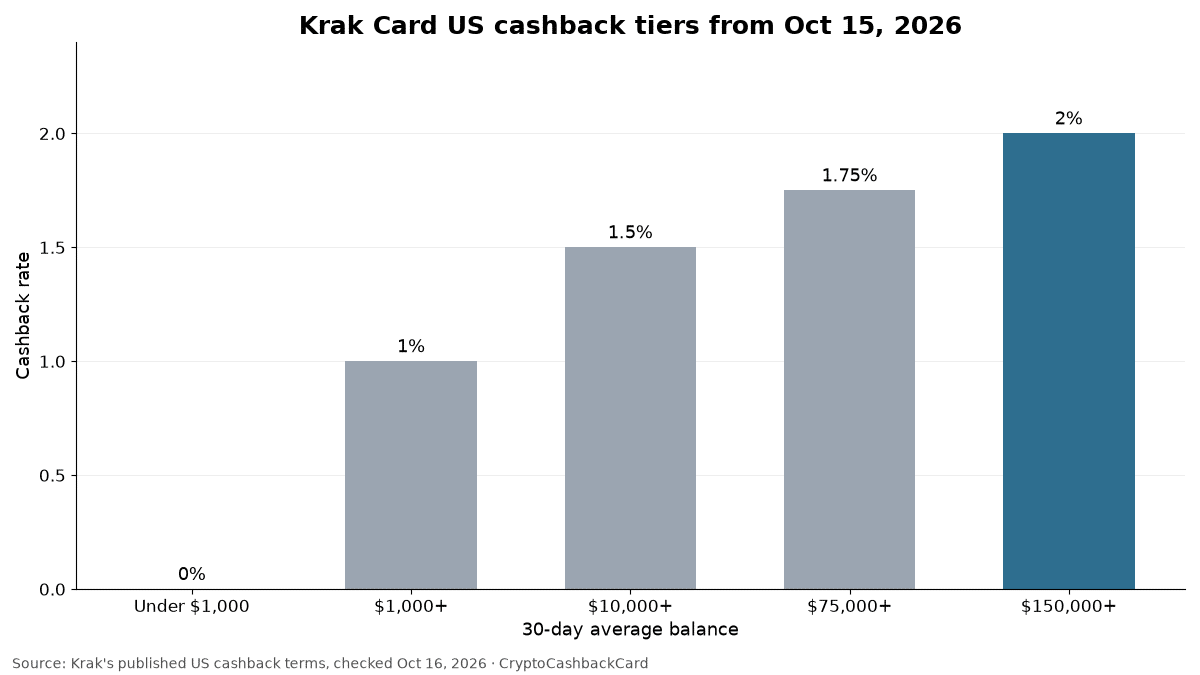
| Tier | 30-day average, before | Rate before | 30-day average, after | Rate after |
|---|---|---|---|---|
| Starter | under $200 | 0% | under $1,000 | 0% |
| Lite | $200+ | 0.5% | $1,000+ | 1% |
| Pro | $1,000+ | 1% | $10,000+ | 1.5% |
| Elite | $10,000+ | 1.5% | $75,000+ | 1.75% |
| Max | $50,000+ | 2% | $150,000+ | 2% |
Names moved up the ladder: the old “Pro” ($1,000) is now “Lite”. Compare balances and rates, not names.
What changed, by balance
Comparing the two tables band by band (our arithmetic):
- Under $200: 0% before, 0% after.
- $200 to $999: 0.5% before, 0% after. Down.
- $1,000 to $49,999: unchanged (1% up to $9,999, 1.5% from $10,000).
- $50,000 to $74,999: 2% before, 1.5% after. Down 0.5 points.
- $75,000 to $149,999: 2% before, 1.75% after. Down 0.25 points.
- $150,000 and up: 2% before, 2% after.
So the people most affected hold under $1,000 or between $50,000 and $149,999. Krak’s pages do not mention a grace period for existing cardholders.
Break-even maths
Cashback is rate x eligible spend. We use $3,000 of monthly spend, one of the examples on Krak’s own marketing page. Other spend levels scale in a straight line.
At $3,000 a month:
- 0% earns $0.
- 1% earns $30 a month ($360 a year).
- 1.5% earns $45 ($540 a year).
- 1.75% earns $52.50 ($630 a year).
- 2% earns $60 ($720 a year).
What each step up costs in balance, and pays:
| Step | Extra balance | Extra rate | Extra cashback at $3,000/month | Spend needed to gain $100 a year |
|---|---|---|---|---|
| Starter to Lite | $1,000 | +1.00 pt | $30/month | $10,000 a year |
| Lite to Pro | $9,000 more | +0.50 pt | $15/month ($180/year) | $20,000 a year |
| Pro to Elite | $65,000 more | +0.25 pt | $7.50/month ($90/year) | $40,000 a year |
| Elite to Max | $75,000 more | +0.25 pt | $7.50/month ($90/year) | $40,000 a year |
Worked example: Lite to Pro pays $180 a year on $9,000 extra balance, 2.0% of that extra. Pro to Elite pays $90 on $65,000, about 0.14%. Elite to Max pays $90 on $75,000, 0.12%.
Krak says your balance stays spendable and is not locked. The real cost is what that money could earn elsewhere; we have no sourced figure, so compare it yourself. The top two steps only make sense with high spend, or if you would hold the money on Krak anyway.
How the 30-day average works
Krak sets your tier from your average balance over 30 days across Krak, Kraken and Kraken Pro, worked out once a day. A deposit is spread evenly over 30 days, so it adds one-thirtieth of its size to your average each day.
Krak’s own example: average $1,000, deposit $300. The average rises $10 on day one to $1,010, about $1,150 at day 15 and $1,300 at day 30, if nothing else changes.
Our examples, same rule, nothing else changing:
- Average $1,000, deposit $9,000: adds $300 a day. Day 15: $5,500. Day 30: $10,000, so Pro arrives on day 30.
- Average $10,000, deposit $65,000: adds about $2,167 a day. Day 15: $42,500. Day 29: about $72,833 (still Pro). Day 30: $75,000, Elite.
- Average $75,000, deposit $75,000: adds $2,500 a day. Day 15: $112,500. Day 30: $150,000, Max.
A big deposit does not unlock a tier the same day. Krak’s pages do not spell out how withdrawals reduce the average. Going by the daily-balances rule, a withdrawal would pull it down gradually, but that is our inference.
The page mismatch (with capture dates)
On 2026-10-15 at 11:30 AM CT we captured:
- Support overview, legal cashback terms and Rewards FAQ: new table, 2% needs $150,000.
- Marketing page (krak.app/us/card/cashback): a four-row table with $50,000 for 2%, $10,000 for 1.5%, $1,000 for 1%, and 0.5% under $1,000.
The marketing table does not match the new numbers. It also differs from the earlier support table, which gave 0.5% only from $200 and 0% under $200.
We re-checked the live pages at about 12:30 PM CT the same day. The support overview, legal cashback terms, Rewards FAQ, metal card page and welcome terms all showed the new table. Two marketing pages still showed the old numbers: krak.app/us/card/cashback (the four-row table above) and the main card page, krak.app/card, which says the Metal Card and maximum cashback require “an average $50,000 in combined assets.” Krak’s terms say tiers and rates can change “from time to time” and point users to the app or site for the latest. Treat the app’s Rewards hub as the authority for your own account.
Other rules that matter
- Settlement timing: your rate is the tier you hold when the merchant finalizes the purchase, not when you swipe. Authorize on Monday, settle Tuesday, and Tuesday’s rate applies. Krak says this typically takes 24 hours but can take longer. Cashback shows as pending, then is paid to your Krak balance shortly after.
- Payout: USD (default) or BTC. With BTC the value can move before payout.
- Exclusions: ATM withdrawals, refunds, reversals, chargebacks, transfers and funding, and purchases under $0.49. The legal terms also exclude cash and quasi-cash, gift cards and prepaid, financial products, gambling and government payments. The metal card page says a $0.50 minimum, a small mismatch.
- Cap: Krak says there are currently no daily or monthly cashback caps. Your spending limits can still limit what you earn.
- States: not available in all states. Krak’s getting-started page lists New York, Maine, Massachusetts and Indiana as unavailable. Check before you apply.
- Welcome window: new customers get top-tier (2%) rewards for their first 30 days, then the 30-day average applies. A new customer holding $10,000 would fall from 2% to 1.5% after day 30.
- Tier checks: the support page says once daily, the legal terms say hourly. We could not tell which is right.
- Metal card: Krak’s metal card support page (updated October 15, 2026) says you qualify with $150,000 or more in assets on the platform, the same as the Max tier. The main card page still says $50,000. First card free; replacements cost $60.
- Tax: Krak says cashback is generally not taxable. The IRS has not ruled on card rewards specifically; our guide explains why spending rewards are usually treated as a rebate, and when selling them can trigger tax. Ask a tax adviser for your own situation.
Who it suits
- Everyday spenders holding $1,000 to $49,999 on Krak: rates did not change.
- People already holding $150,000 or more.
- Anyone who is happy with 1.5% to 1.75% and does not need the top rate.
Who should look elsewhere
- Holders of $50,000 to $149,999 who joined for 2%.
- People with under $1,000, who now earn 0%.
- Anyone in New York, Maine, Massachusetts or Indiana.
- People who want a credit card or deposit insurance: Krak balances are not FDIC- or SIPC-insured. See how other crypto cashback cards compare on rates and fees, or, for a credit card example, why some Gemini purchases earn 1% instead of 4%.
FAQ
What are the Krak Card US cashback tiers now?
Starter under $1,000 (0%), Lite $1,000 (1%), Pro $10,000 (1.5%), Elite $75,000 (1.75%), Max $150,000 (2%), on the 30-day average.
What is the Krak Card 2% requirement?
A 30-day average of $150,000 across Krak, Kraken and Kraken Pro. New customers get 2% for 30 days.
What is the Krak Card cashback change?
Higher balance thresholds, a new 1.75% tier, and 0% below $1,000, effective October 15, 2026.
What is the Krak Card metal card requirement?
$150,000 in assets on the platform, per Krak’s metal card support page updated October 15, 2026. The main card page still shows the older $50,000 figure.
Which states can get the Krak Card?
Not all. New York, Maine, Massachusetts and Indiana are listed as unavailable. Check the app.
Is this a Krak Card review for US users?
No. We have not used the card. This explains Krak’s published rules.
Sources
All checked 2026-10-15. Captures taken at 11:30 AM CT.
- Support overview
- Legal cashback terms
- Marketing page
- Rewards FAQ
- Metal card
- Welcome terms
- Getting started (states)
- Krak Card page (states, older $50,000 figure)
Read next
Are crypto card rewards taxable?
Whether the crypto you earn is taxed when it lands or only when you sell, and what H.R. 10357 would change.
Which merchants earn 4% on Gemini
Why some gas stations and grocery stores pay only 1%, based on what cardholders report.
Coinbase taxes: forms and how to file
Which forms Coinbase sends, what changes between tax years 2025 and 2026, and how the numbers land on Form 8949.
Disclaimer and disclosure
This page has no affiliate or referral links. CryptoCashbackCard is an independent site, not affiliated with or endorsed by Kraken or Krak. Figures are Krak’s published numbers; the break-even maths is our own arithmetic and is not financial advice.
Spot an error or have a concern about this page? Email us at hello@cryptocashbackcard.com and we will review it promptly.