
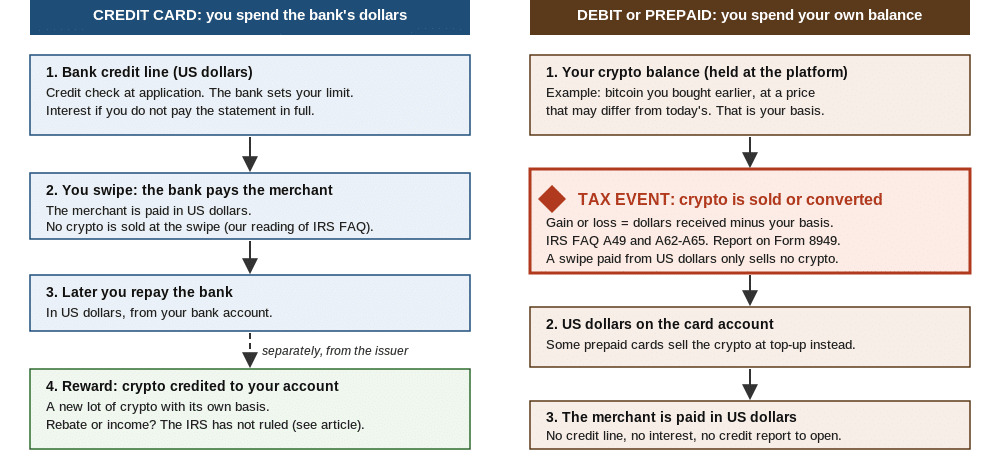
By the CryptoCashbackCard Editorial Team. Facts checked November 14, 2026 and re-checked November 16, 2026. Last updated November 16, 2026.
Crypto credit card vs debit card sounds like a small choice, but it changes your credit check, your fraud rights and your tax bill. A crypto credit card is a bank credit line that pays rewards in crypto: you spend the bank’s dollars. A crypto debit card spends your own balance, and when that balance is crypto, the sale happens at the register. This guide compares the two designs for US readers, using issuer documents, the IRS and federal regulators. For rates card by card, see our best crypto cashback cards page.
We did not use or test any card for this page. Everything below comes from issuer documents, the IRS and federal regulators, with the date we read each one. This page is general information, not tax, legal or financial advice. This page has no affiliate or referral links. CryptoCashbackCard is an independent site, not affiliated with any card issuer.
The short answer
- Credit card: you borrow US dollars from a bank. It runs a credit check, charges interest if you carry a balance, and pays crypto only as a reward. No crypto is sold when you swipe (our reading of the IRS rules).
- Debit or prepaid card: you spend your own balance and there is no credit line. If the money is crypto, each swipe sells or converts it. The IRS treats that as a disposal of property, so each swipe can create a gain or loss you report on Form 8949.
- Collateral: the Gemini, Coinbase One and Crypto.com credit cards we checked do not ask for crypto collateral on their standard cards. One exception: Coinbase may offer a Coinbase One Card secured by a USDC deposit.
- Fraud rules: both types have federal limits on what you lose. Credit is simpler. Debit and prepaid limits depend on how fast you report, and prepaid limits depend on your identity check being complete.
- Which to get: credit if you pay in full and want crypto rewards without selling anything. Debit or prepaid if you want to spend crypto you hold, with no credit check, and you will keep tax records.
Where the money comes from
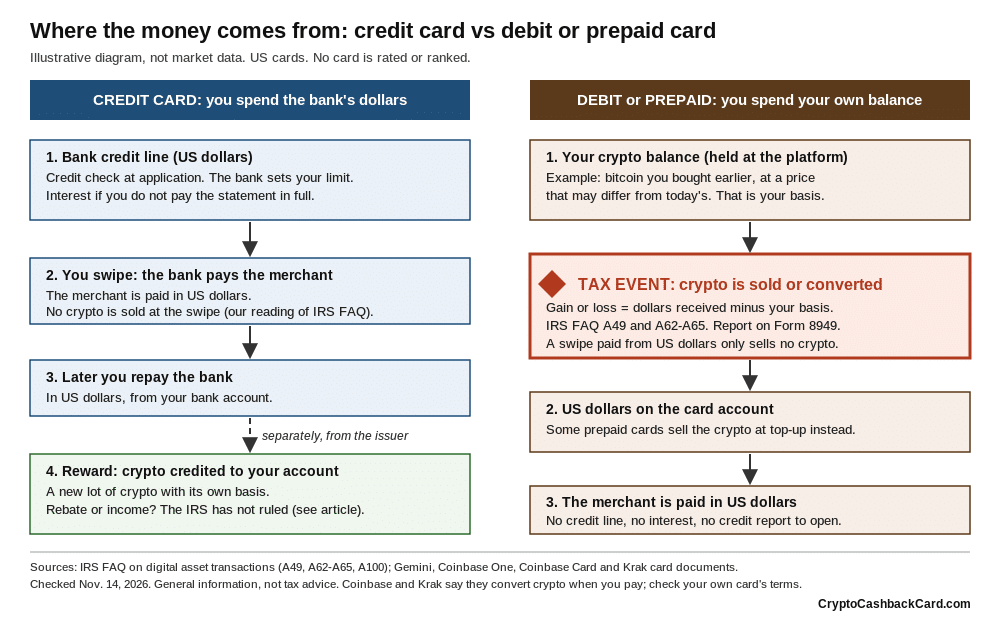
The two cards look the same at the checkout. Behind the terminal they are different machines. This diagram shows who pays the merchant, and where the tax event sits. Mastercard’s own explainer draws the same line: a crypto credit card means “borrowing fiat currency from the issuer, not the card network,” while a crypto debit card “connects directly to your existing balance of assets” S36.
Our comparison of US Visa crypto cards walks through that same “where the money comes from” question for Visa-branded cards, including prepaid and self-custody designs.
Crypto credit card vs debit card: the decision matrix (US, checked Nov. 14, 2026)
Each cell shows the source tag and the date we read it. Where a cell carries an earlier read or an older agreement, it says so. “Not disclosed” means the issuer’s pages are silent. This table compares crypto debit vs credit card designs, using Gemini, Coinbase One and Crypto.com as the credit examples and Coinbase Card and Krak Card as the debit or prepaid examples. It does not rank cards.
| What you want to know | Crypto credit card (a bank credit line) | Crypto debit or prepaid card (your own balance) |
|---|---|---|
| Funding source | A bank credit line in US dollars. Gemini: issued by WebBank S1. Coinbase One Card: First Electronic Bank, Amex network S5 S9. Crypto.com Visa Signature: Comenity Capital Bank S11. Crypto is paid as a reward, not used to pay. Checked 11/14/26 |
Your own balance. Coinbase Card: Visa prepaid debit, Pathward N.A.; crypto is converted to US dollars automatically S13. Krak Card: Visa debit, Lead Bank; the card account holds only dollars and Kraken converts crypto to fund each transaction S19. Checked 11/14/26 |
| Credit check | Yes, on all three. Gemini: soft-pull prequalification, then a hard inquiry that “can impact your credit score” S2. Coinbase One: seeing if you are approved does not affect your score; a hard check runs only if you accept S5. Crypto.com: soft-inquiry prequalification, then credit approval S11. Checked 11/14/26 |
No credit report to open. Coinbase Card: “no application fee or credit check” S14. Krak: “you will not be subject to a credit report in order to open your Card”; ID and SSN verification apply S19 S17. Krak’s terms still allow later inquiries that “may include” credit reports S19. Checked 11/14/26 |
| Credit-score effect | A hard inquiry when you accept (Gemini, Coinbase One). Crypto.com’s issuer may share account information with credit bureaus S12. Gemini’s and Coinbase One’s own bureau-reporting wording: not read. Checked 11/14/26 |
No credit line to report. Whether the Coinbase Card or Krak Card reports to bureaus: not disclosed on the pages we read. Checked 11/14/26 |
| Fraud liability and disputes | Federal cap: liability for unauthorized use “shall not exceed the lesser of $50” or the amount obtained before you notify the issuer S24. Billing errors: written notice within 60 days of the statement; the issuer must resolve within two billing cycles, 90 days at most S25. Coinbase One’s agreement: “your liability will not exceed $50”; you need not pay a disputed amount while it investigates S9 S10. Checked 11/14/26 |
Regulation E: $50 if you tell the bank within two business days, up to $500 after, and more if you miss the 60-day statement window S26. Krak’s Lead Bank terms say the same S19. Prepaid accounts get Regulation E style protection under the CFPB prepaid rule S28, but an issuer need not apply the limits to an account whose identity check is not complete S27. Coinbase Card’s agreement (dated Oct. 2024, OLD) has the same $50/$500 structure S16. Checked 11/14/26; Coinbase agreement carried from 11/7/26 |
| Tax on each swipe | The swipe sells no crypto (our reading of IRS FAQ A48-A49 and A62-A65; no IRS page says it in one line) S20. The reward is a separate question: rebate or income, not settled (see below). Checked 11/14/26 |
A swipe funded by crypto is a disposal: gain or loss is what you received minus your basis, reported on Form 8949 S20. Coinbase and Krak say the same S15 S18. A swipe funded by US dollars only creates no crypto disposal S18. Checked 11/14/26 |
| Rewards form | Crypto, paid by the issuer: Gemini in bitcoin or 50+ coins S1; Coinbase One in bitcoin S8; Crypto.com in CRO or BTC S11. Checked 11/14/26 |
Coinbase Card: optional, variable crypto rewards, “Check your app” S13. Krak: cashback in USD or BTC, set by a 30-day balance tier (read on our Krak page 11/14/26, which cites Krak’s Oct. 15, 2026 overview). Checked 11/14/26 |
| Fees to check | Annual fee: none on Gemini S1, none on Coinbase One with a Coinbase One membership from $49.99 a year S9 S6, none on Crypto.com S11. Foreign transaction fee: none on Gemini and Coinbase One; 3.0% on Crypto.com S12. Interest: variable APR, 16.74% to 34.74% on Gemini S3, 19.74% to 29.74% on Coinbase One S9 and 17.74%, 25.74% or 31.74% on Crypto.com S12, set by creditworthiness. Checked 11/14/26; Crypto.com re-checked 11/16/26 |
No interest (no credit line). Coinbase Card: “zero spending fees” but “a spread applies” when crypto is converted; the spread is not disclosed S13. Krak: 1% foreign transaction fee S19; conversion spread not disclosed as a percentage. Checked 11/14/26 |
| US availability | Gemini: US residents; its launch text said all 50 states, and we did not re-read a current state list S4. Coinbase One: US only, excluding territories S6. Crypto.com: states where its app is offered; New York restricted S37. Checked 11/14/26; Crypto.com re-checked 11/16/26 |
Coinbase Card: all US states except Hawaii S13. Krak: not in New York, Maine, Massachusetts or Indiana S17. Checked 11/14/26 |
Do crypto credit cards need collateral?
Not the ones we checked. For Gemini, Coinbase One and Crypto.com, the application is a credit check, and the bank or issuer sets your limit S2 S6 S11. None of the pages we read asks for a crypto deposit as a condition of the standard card. Crypto.com’s CRO lock-up is tied to its reward tiers, not the credit line: its page says “select the ‘Basic’ tier” if you do not want to subscribe or lock up S11.
One documented exception. Coinbase says that if it cannot offer you the standard Coinbase One Card, it may offer a version secured by a USDC deposit S7:
- You pick a limit between $100 and $5,000, and that amount is taken from your USDC balance. The limit equals the deposit.
- The deposit “cannot be traded, withdrawn, lent or transferred” while the card is open S8. If the account is closed or in default, it is applied to what you owe.
- You still need a Coinbase One membership (from $49.99 a year) and still pass a credit review S7.
- How Coinbase treats the deposit for tax is not stated on the pages we read.
Collateral-backed cards exist, but they are a different product. Plasma’s US card terms say the credit limit is “determined, in part, by the amount of available Collateral” S32. Bitcoin.com describes the Nexo Card as a crypto-backed credit line offered in selected European markets rather than the US, and notes that if the collateral falls in value some can be sold to cover the loan S33. We did not check which US states can open Plasma’s card, and Nexo’s own page was not read. If a guide says all crypto credit cards borrow against your crypto, check the issuer’s agreement and the date at the top of the guide. Cards also disappear: the BitPay Card stopped taking loads on June 1, 2023 and stopped spending on June 15, 2023, according to CryptoSlate S35.
Self-custody and wallet-linked cards. A third design pulls stablecoins from a wallet you control. Labels vary (debit, credit, or just “a Visa card”), so read the agreement. A stablecoin spend is still a disposal under IRS FAQ A100 S20, though Coinbase and Krak both say the gain or loss is usually near zero while the coin trades at about $1.00 S15 S18.
Is a crypto debit card taxable? Tax on every swipe
Yes, when crypto funds the swipe. The IRS treats digital assets as property (FAQ A48; Notice 2014-21, as modified by Notice 2023-34) S20 S22. Under its FAQ, selling digital assets for dollars means you recognize a capital gain or loss (A49). Paying for services with digital assets is a disposal (A62), and exchanging them for other property recognizes gain or loss (A64). Gain or loss is your amount realized minus your adjusted basis (A52, A65), and fees paid to effect the sale reduce the amount realized (A53). The IRS answers we read set no dollar minimum, and we found no small-purchase exemption in them. That is our reading of silence, not an IRS sentence.
- What the issuers say. Coinbase: “Each time you use your card and sell cryptocurrency, it is treated as selling property in a taxable transaction” S15. Krak: if no crypto is sold or converted, “the purchase does not create a crypto disposal” S18.
- When the sale happens. Coinbase says it converts crypto automatically when you spend S13; Krak says assets are converted at purchase S17. Some prepaid cards sell the crypto when you top up instead, which moves the tax event to the top-up. Read your card’s agreement.
- Stablecoins. The IRS says you recognize gain or loss on stablecoins held as capital assets “even if your broker does not report the transactions” (A100). Coinbase says USDC at par “should not result in a taxable gain or loss” S15. Both fit together: it is a disposal, and the gain is usually near zero. Bills that would exempt some stablecoin payments, including S. 5616 and H.R. 10357, are not law: as of Nov. 4, 2026 H.R. 10357 had been ordered reported by the House Ways and Means Committee, 38-5, with no House floor vote, and bills not enacted by Jan. 3, 2027 expire S30 S31.
- Reporting. The IRS says to report taxable transactions “regardless of the amount or whether you receive a payee statement” (A108), on Form 8949 (A109) S23, and its digital assets page adds that you must report them “whether or not they result in a taxable gain or loss” S21. See our Form 8949 guide for the boxes. Whether a card swipe appears on a Form 1099-DA at Coinbase, Krak or Crypto.com is not stated on the pages we read.
Worked example (ILLUSTRATIVE: invented numbers, not a real account or real prices)
You buy $50.00 of groceries. Assume bitcoin is $125,000 at the swipe. We set fees and spread to $0 for clarity; real ones reduce your amount realized.
Path 1: debit or prepaid card funded with bitcoin. $50.00 / $125,000 = 0.0004 BTC sold. Amount realized is $50.00.
| Case | You paid per bitcoin | Basis of the 0.0004 BTC | Gain or loss on the swipe |
|---|---|---|---|
| A: bought lower | $100,000 | 0.0004 x $100,000 = $40.00 | $50.00 – $40.00 = +$10.00 gain |
| B: bought higher | $150,000 | 0.0004 x $150,000 = $60.00 | $50.00 – $60.00 = -$10.00 loss |
Partial-sale check: say you hold one lot of 0.0010 BTC that cost $100.00. Selling 0.0004 BTC uses basis (0.0004 / 0.0010) x $100.00 = $40.00, so the gain is $10.00 as in Case A, and the 0.0006 BTC left has basis $60.00 ($40.00 + $60.00 = $100.00). Whether the gain is short-term or long-term depends on your own purchase dates S20. The same swipe funded with $50.00 of USDC that you bought at $50.00 has a $0.00 gain, but is still a disposal.
Path 2: credit card paid in dollars, bitcoin reward. You pay $50.00 on the card and later repay the bank $50.00 in dollars. No crypto is sold. Suppose the card pays a 2% reward (invented rate, not any card’s): 2% x $50.00 = $1.00 = 0.000008 BTC at $125,000. If bitcoin later rises to $150,000 and you sell, you receive 0.000008 x $150,000 = $1.20.
| View of the reward | Income at receipt | Basis | Gain on the later $1.20 sale |
|---|---|---|---|
| Rebate view, basis = value when credited | $0.00 | $1.00 | $1.20 – $1.00 = $0.20 |
| Income view | $1.00 | $1.00 | $1.20 – $1.00 = $0.20 |
| Rebate view, zero basis (some argue this) | $0.00 | $0.00 | $1.20 – $0.00 = $1.20 |
If you do not repay the $50.00 in full by the due date, interest at the card’s APR applies; we did not compute it. We worked these numbers by hand; please re-check them in a spreadsheet before relying on them.
Credit card rewards: rebate or income?
The IRS has not issued guidance written for crypto card rewards. Rewards earned by spending are commonly treated as a rebate, a reduction in what you paid, not as income. That view rests on IRS Publication 525’s rule that a cash rebate “isn’t income, but you must reduce your basis” S34, applied by analogy. The other view is that the reward is income when you receive it, as the IRS says crypto received for services is. The difference matters because you made a purchase to earn the reward, which is why the rebate view is not settled. Bonuses that need no spending, such as for opening an account, may be treated as income. Either way, selling or spending the reward later is a disposal. Coinbase says its bitcoin back “will not be reflected in the 1099 Tax forms” and “If you sell your bitcoin rewards, taxes might apply” S8. For the full discussion, see our guide on whether crypto credit card rewards are taxable.
Fraud and dispute rules: credit vs debit vs prepaid
Credit cards have the simplest rule: your liability for unauthorized use is capped at $50 by regulation S24, and a billing-error notice within 60 days starts a process that must finish within two billing cycles S25. Debit and prepaid cards run on Regulation E, where the $50 cap applies only if you report within two business days, the cap rises to $500 after that, and you can lose more if you miss the 60-day statement window S26. For prepaid accounts, the CFPB rule extends these protections S28, but the regulation lets an issuer skip them for an account whose identity verification is not complete S27. Finish verification before you load money.
There is also a practical difference. On debit and prepaid, the money has already left your balance while a dispute runs; the bank generally owes a temporary credit only if its investigation runs past ten business days S29. On a credit card, Coinbase says you need not pay a disputed amount during the investigation S10. None of this protects the crypto sitting in your exchange account; our crypto card safety guide covers that separate risk.
Which one should you get?
- Choose a credit card if you pay the statement in full each month, want to earn crypto without selling any, and are fine with a credit check. If you carry a balance, interest (Gemini’s range starts at 16.74% S3) can outweigh rewards; our Gemini Credit Card review works through the math for that card.
- Choose a debit or prepaid card if you want to spend crypto you already hold, want no credit line and no interest, and will track each swipe’s gain or loss. Rewards on these cards often depend on balance: Krak’s tiers, for example, are covered in our Krak Card cashback tiers guide. Check your state first, since Hawaii (Coinbase Card) and New York, Maine, Massachusetts and Indiana (Krak) are excluded S13 S17.
- If you want to avoid tax tracking on a debit or prepaid card, fund it with US dollars only: no crypto is sold on that swipe S18. You then give up spending crypto directly.
- If your credit is thin or damaged, Coinbase’s USDC-secured version is one documented route, with the membership fee, the credit review and a locked deposit as costs S7. Approval is not guaranteed.
What we could not confirm
- The crypto conversion spread on the Coinbase Card and Krak Card: not disclosed as a percentage.
- Whether card spending appears on a Form 1099-DA at Coinbase, Krak or Crypto.com.
- How Coinbase treats the USDC security deposit for tax.
- Whether the Coinbase Card or Krak Card reports to credit bureaus, and Gemini’s and Coinbase One’s own bureau-reporting wording.
- Gemini’s current state list, and which states can open Plasma’s collateral-backed card.
- A current Coinbase Card cardholder agreement: the one Coinbase links is dated Oct. 14, 2024.
- Whether the IRS will issue guidance on crypto card rewards, or whether any stablecoin or de minimis bill becomes law.
Sources
All pages read or excerpted on Nov. 14, 2026 unless marked. “Carried” means read in an earlier campaign; “OLD” means the document is older than 12 months.
- S1. Gemini Credit Card
- S2. Gemini: Credit Card Application Process
- S3. Gemini Credit Card Cardholder Agreement, Sept. 25, 2026
- S4. Gemini: Product Overview (launch-era text, undated, OLD)
- S5. Coinbase Help: Coinbase One Card overview
- S6. Coinbase Help: How to apply for a Coinbase One Card
- S7. Coinbase Help: Coinbase One Card with security deposit
- S8. Coinbase One Card
- S9. Coinbase One Card Cardholder Agreement, effective Nov. 1, 2026
- S10. Coinbase Help: Coinbase One Card declines and disputes
- S11. Crypto.com Visa Signature Credit Card
- S12. Comenity Capital Bank: Crypto.com credit card agreement
- S13. Coinbase Card
- S14. Coinbase Help: Coinbase Card debit card overview
- S15. Coinbase Help: Coinbase Card fees and taxes
- S16. Coinbase Card terms (links the Pathward agreement dated Oct. 14, 2024, OLD; agreement text carried from Nov. 7, 2026)
- S17. Krak: Getting started with the US Krak Card
- S18. Krak: US Krak Debit Card tax information
- S19. Lead Bank: Krak Card issuing bank terms, Aug. 3, 2026
- S20. IRS: Frequently asked questions on digital asset transactions (page reviewed June 29, 2026; answers A47-A65, A100, A108, A109)
- S21. IRS: Digital assets
- S22. IRS Notice 2014-21 (property treatment, carried from Nov. 7, 2026; modified by Notice 2023-34)
- S23. IRS: Instructions for Form 8949
- S24. 12 CFR 1026.12, Special credit card provisions (CFPB)
- S25. 15 U.S.C. 1666, Correction of billing errors
- S26. 12 CFR 1005.6, Liability of consumer for unauthorized transfers (eCFR)
- S27. 12 CFR 1005.18, Requirements for financial institutions offering prepaid accounts (eCFR)
- S28. CFPB: Finalizes strong federal protections for prepaid account consumers (archived)
- S29. CFPB: How do I get my money back after I discover an unauthorized transaction?
- S30. Digital Asset Tax Action: What the election means for pending digital asset tax bills (updated Nov. 4, 2026; secondary)
- S31. EY Tax News: Ways and Means approves digital assets tax bill (secondary)
- S32. Plasma: U.S. Consumer Card Terms (agreement dated Feb. 12, 2026)
- S33. Bitcoin.com: What is a crypto credit card? (Sept. 4, 2026; secondary, not an issuer page)
- S34. IRS Publication 525: Taxable and Nontaxable Income (quote carried through our rewards-tax guide)
- S35. CryptoSlate: BitPay Card review (secondary)
- S36. Mastercard: What is a crypto card? (Apr. 13, 2026; read in full Nov. 16, 2026)
- S37. Crypto.com Help: In which US states is the Crypto.com App available? (read Nov. 16, 2026)
Disclaimer
This page is general educational information, not tax, legal or financial advice. Tax rules depend on your individual facts and can change. The worked example uses invented numbers and is not a real account or real prices. The IRS has not issued guidance specific to crypto credit card rewards, and the treatment described here may not apply to you. Consult a qualified tax professional before making decisions or filing a return. Card terms, fees and availability change; confirm them with the issuer before you apply. CryptoCashbackCard is an independent site, not affiliated with or endorsed by Gemini, Coinbase, Crypto.com, Kraken or any card issuer. This page has no affiliate or referral links.
Spot an error or have a concern about this page? Email us at hello@cryptocashbackcard.com and we will review it promptly.