

Yes. If you sold, swapped or spent crypto for less than your basis, that is a capital loss, and you can use it. Tax loss harvesting crypto means selling coins that are worth less than you paid so the loss can offset gains, and then up to $3,000 of other income. The part most guides get wrong is the wash-sale rule: the statute covers “stock or securities,” and as of Nov. 2, 2026 we found no enacted law that extends it to spot crypto. A pending House bill would, if enacted as written, for sales after Sept. 14, 2026. This guide covers the law as it stands, the bill, how a loss is reported on Form 8949, and one worked example built from small crypto card rewards, because each reward is its own lot.
This page is general information, not tax advice. Talk to a qualified tax professional before you sell, buy back or file. CryptoCashbackCard is an independent site. This page has no affiliate or referral links. We did not test any account or tool, and the worked example uses made-up numbers.
Last updated Nov. 2, 2026. US federal tax only. The wash-sale facts below were checked on congress.gov and in the statute on this date. Bills can change. Not law as of Nov. 2, 2026 means exactly that: check again before you rely on it.
The short answer
- You can claim a crypto loss, but only after you sell or otherwise dispose of the crypto. Holding a coin that fell is not a loss on your return. The IRS says digital assets are property, and selling, swapping or spending them is a disposition with a capital gain or loss.
- How much counts: losses offset capital gains in full. If losses are bigger than gains, you can deduct up to $3,000 ($1,500 if married filing separately) against other income. The rest carries forward.
- Wash sales: section 1091 covers “stock or securities.” We found no enacted law or IRS guidance that extends it to crypto that is not also a security. That is the law today, not a statement that the IRS “allows” wash sales.
- Pending: three bills would change this. As amended in committee on Sept. 16, H.R. 10357 would apply a crypto wash-sale rule to dispositions after Sept. 14, 2026. It is not law. Talk to a tax professional before relying on a same-day buy-back.
- Tokenized securities and crypto ETFs can already be subject to the wash-sale rule.
- No 1099-DA needed: you report a loss on Form 8949 whether or not you get a form.
- Crypto card rewards: each reward is a small lot. Whether a reward has a basis you can lose from depends on how it is treated: income view or rebate view. The IRS has not said for card rewards.
Can you claim crypto losses on your taxes? How a loss works
This guide assumes you hold crypto as a capital asset (the usual case for an investor or card user), not as a dealer or business inventory. A loss happens on a disposition. For crypto, the IRS lists selling for dollars, swapping for another digital asset and paying for goods or services. Your loss is your adjusted basis minus your amount realized, and fees paid to complete the sale reduce the amount realized (IRS FAQ on digital asset transactions, A49, A52, A62 and A64).
- Short-term or long-term: one year or less is short-term; more than one year is long-term. The holding period begins the day after you acquired the crypto and ends on the day you sell it (FAQ A50, A74).
- Why it matters: net short-term gains are taxed as ordinary income at graduated rates (IRS Topic 409). Which kind of gain a loss offsets changes how much it saves you. We do not compute tax rates here.
- A drop is not a loss yet. An IRS Chief Counsel memo (2023, not precedent) said a taxpayer who still held crypto that had fallen below a cent, and could still sell it, had not sustained a loss, because it was not worthless or abandoned (CCA 202302011). Selling is what makes the loss real.
Tax loss harvesting crypto: the $3,000 limit, netting and carryover
The IRS rule in plain terms: you can deduct capital losses up to your capital gains plus $3,000 ($1,500 if married filing separately). If your total net loss is smaller than $3,000, you deduct the net loss. You claim it on Form 1040, and any excess carries forward (Topic 409; Schedule D instructions). The Capital Loss Carryover Worksheet in Pub. 550 or the Schedule D instructions tells you how to carry the rest.
- Step 1: add up all your gains and losses for the year across crypto, stocks and anything else on Form 8949. Losses offset gains first.
- Step 2: if you still have a net loss, deduct up to $3,000 ($1,500 MFS).
- Step 3: carry anything left to next year.
The loss counts in the year of the sale: the IRS says to report income, gain or loss for the taxable year of the transaction (FAQ A108). We did not verify exchange cut-off times, time zones or settlement rules for a Dec. 31 sale, so do not leave it to the last hour.
Does the wash-sale rule apply to crypto in 2026?
What the law says today
Section 1091 of the Internal Revenue Code disallows a loss on the sale of “shares of stock or securities” if, within a period starting 30 days before the sale and ending 30 days after it, you acquire “substantially identical stock or securities” (26 U.S.C. 1091). That window is 61 days with the sale day. The loss is not erased: the disallowed amount is added to the basis of the replacement.
The IRS treats digital assets as property, not currency (IRS digital assets page). We read the IRS digital assets page, both parts of its FAQ (Q1-Q46 and A47-A109) and the 2025 Schedule D instructions. None extends the wash-sale rule to crypto that is not also a security. The Schedule D instructions say the rules “generally apply to transactions involving digital assets that are also stock or securities for tax purposes (tokenized securities).” In short: the statute does not cover plain spot crypto. That describes what the law reaches today, not an IRS approval of any trade.
Some explainers get this backwards. At least one widely syndicated guide says you must buy a similar asset back within 30 days to claim a loss. For stocks the effect is the opposite: buying back inside the window can disallow the loss.
The pending bills: not law as of Nov. 2, 2026
| Bill | Status on congress.gov (Nov. 2, 2026) | Wash-sale effective date, as the text reads |
|---|---|---|
| H.R. 10357, Digital Asset Tax Certainty Act (Rep. Smith) | Introduced Sept. 14. Ways and Means ordered it reported as amended, 38-5, on Sept. 16. No later action listed. | As amended: dispositions after Sept. 14, 2026. If enacted as written, that could reach sales you have already made this year. |
| H.R. 9172, Applying Existing Tax Anti-Abuse Rules to Digital Assets Act (Rep. Arrington) | Introduced June 8. Referred to Ways and Means. No later action listed. | Dispositions after the date of introduction: after June 8, 2026. |
| S. 5616, ADAPT Act (Sen. Daines and others) | Introduced Sept. 30. Referred to Senate Finance. No later action listed. | Sales and dispositions after enactment. Digital assets acquired before enactment are deemed not covered. |
Each bill would replace “stock or securities” in section 1091 with “specified assets.” H.R. 10357 and S. 5616 define that as stock or securities plus traded digital assets other than qualified dollar stablecoins (we did not read H.R. 9172’s definition). Both also say an acquisition does not count if it is part of “a regular or periodic series of acquisitions” of digital assets that you include in income as ordinary income (we did not check H.R. 9172 for this). We found no source saying whether card rewards would fit that carve-out, so we do not know.
How to read this: not law as of Nov. 2, 2026; a pending bill would reach sales after Sept. 14, 2026 if enacted as written; talk to a tax professional before relying on a same-day buy-back.
If you sell and buy back
- Buying back resets the lot. The new purchase has a new basis (what you paid) and a new holding period that starts the day after (FAQ A56, A50). You keep the crypto, but a long-term position becomes short-term.
- The loss must be real. Treasury regulations say “only a bona fide loss is allowable. Substance and not mere form shall govern in determining a deductible loss” (26 CFR 1.165-1(b)). A tax firm’s note (RSM, Dec. 2025) says a circular trade done only to create a tax loss could be challenged on that ground. That is a general caution. We found no figures on how often it happens.
- Today’s statute does not reach plain spot crypto. A bill could change that for sales already made this year. If H.R. 10357 became law as amended, a same-day buy-back after Sept. 14 could be a wash sale.
Tokenized securities and crypto ETFs
A digital asset that is also a stock or security (a tokenized security) is within the wash-sale rule today. If you receive a 1099-DA, box 1i shows a disallowed wash-sale loss in some cases, and you report it on Form 8949 with code W (Schedule D instructions). Shares of crypto exchange-traded funds are shares in a fund, not crypto held directly. A tax firm says the rule applies to them, so wait 31 days or ask a professional (Gordon Tax; we did not verify this against a primary source).
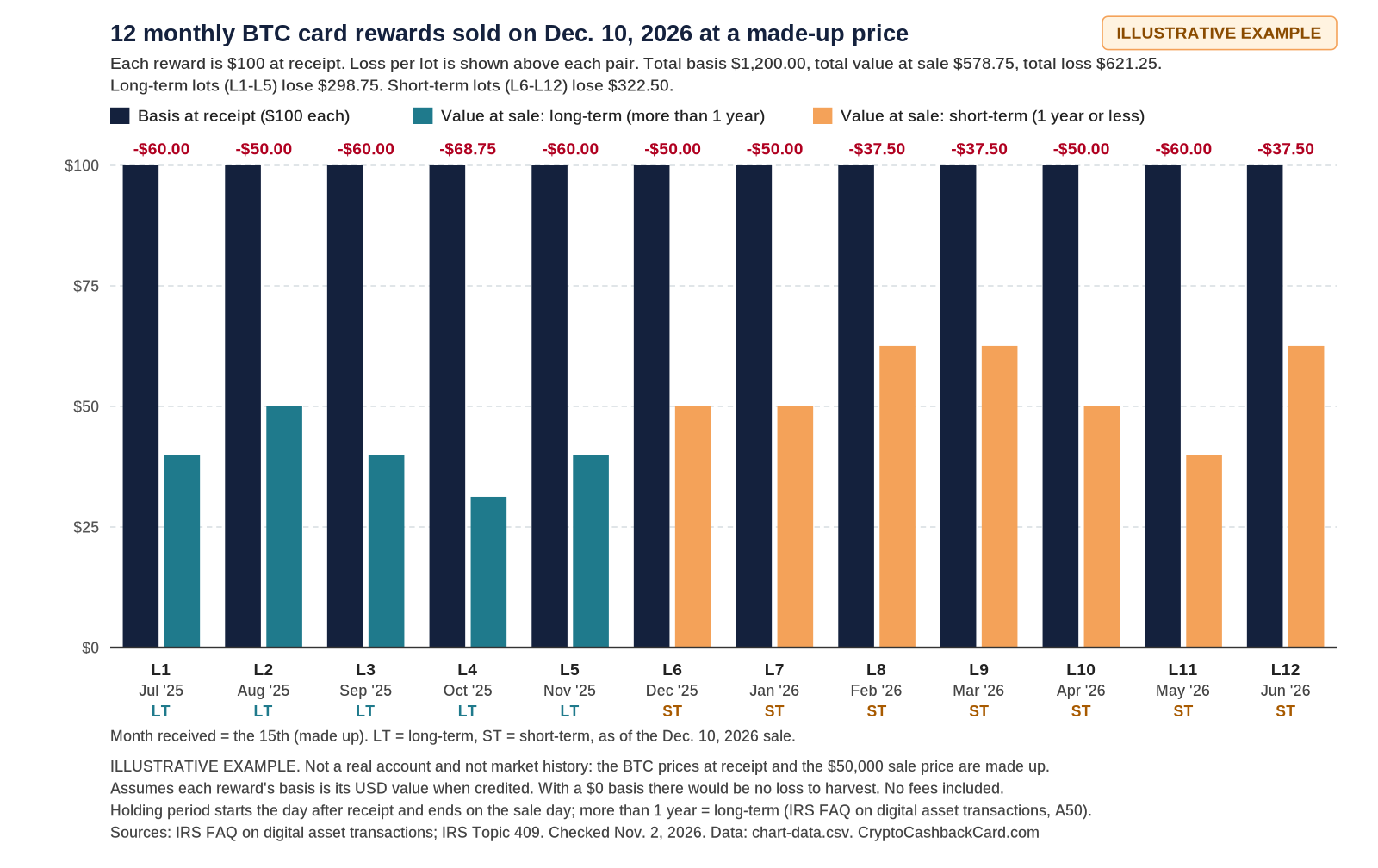
A worked example: 12 monthly BTC card rewards (illustrative, not a real account)
Every number below is made up. We use a $100 bitcoin reward each month and round-number bitcoin prices that are not market history. The example assumes each reward’s basis is its USD value when credited. See the basis question in the next section: with a $0 basis there would be no loss. We include no fees.
Sale: Dec. 10, 2026, at a made-up $50,000 per BTC. Basis per lot: $100.
| Lot | Received | Made-up BTC price | BTC credited | Basis | Value at sale | Loss if sold | At the Dec. 10, 2026 sale |
|---|---|---|---|---|---|---|---|
| L1 | Jul. 15, 2025 | $125,000 | 0.00080000 | $100.00 | $40.00 | $60.00 | Long-term |
| L2 | Aug. 15, 2025 | $100,000 | 0.00100000 | $100.00 | $50.00 | $50.00 | Long-term |
| L3 | Sep. 15, 2025 | $125,000 | 0.00080000 | $100.00 | $40.00 | $60.00 | Long-term |
| L4 | Oct. 15, 2025 | $160,000 | 0.00062500 | $100.00 | $31.25 | $68.75 | Long-term |
| L5 | Nov. 15, 2025 | $125,000 | 0.00080000 | $100.00 | $40.00 | $60.00 | Long-term |
| L6 | Dec. 15, 2025 | $100,000 | 0.00100000 | $100.00 | $50.00 | $50.00 | Short-term |
| L7 | Jan. 15, 2026 | $100,000 | 0.00100000 | $100.00 | $50.00 | $50.00 | Short-term |
| L8 | Feb. 15, 2026 | $80,000 | 0.00125000 | $100.00 | $62.50 | $37.50 | Short-term |
| L9 | Mar. 15, 2026 | $80,000 | 0.00125000 | $100.00 | $62.50 | $37.50 | Short-term |
| L10 | Apr. 15, 2026 | $100,000 | 0.00100000 | $100.00 | $50.00 | $50.00 | Short-term |
| L11 | May 15, 2026 | $125,000 | 0.00080000 | $100.00 | $40.00 | $60.00 | Short-term |
| L12 | Jun. 15, 2026 | $80,000 | 0.00125000 | $100.00 | $62.50 | $37.50 | Short-term |
| Total | 0.01157500 | $1,200.00 | $578.75 | $621.25 | Long-term $298.75 (L1-L5); short-term $322.50 (L6-L12) |
Selling only part: FIFO vs specific identification
If you sell all 12 lots, the method does not matter: the total loss is $621.25. It matters when you sell part. Say you sell 0.006 BTC on Dec. 10, 2026 at $50,000. Proceeds are $300.00.
| Method | Lots used | Basis used | Loss | Long-term | Short-term | Basis left for later |
|---|---|---|---|---|---|---|
| FIFO (the default if you identify nothing) | L1-L6 in full, plus 0.000975 BTC of L7 | $697.50 | $397.50 | $298.75 | $98.75 | $502.50 |
| Specific ID, highest cost first (“HIFO”) | L4, L1, L3, L5, L11, L2, L6 in full, plus 0.000175 BTC of L7 | $717.50 | $417.50 | $298.75 | $118.75 | $482.50 |
- The $20 difference is timing. The highest-cost method uses $20.00 more basis now, so you have $20.00 less basis later. It is not extra loss overall.
- You must identify the units in time. In a wallet you control, identify the units in your records no later than the date and time of the sale. At a broker after Dec. 31, 2025, tell the broker which units, using its identifiers, by the time of the sale. If the broker offers only one method, that method is treated as your standing order. If you identify nothing, the default is earliest-acquired first (FAQ A82, A85-A89).
- “HIFO” is not an IRS term. We use it for specific identification of the highest-cost units. Coinbase lets you choose HIFO, LIFO or FIFO; see our Coinbase taxes guide for how its methods work and what to check before you pick one.
Netting against gains, and the $3,000 limit
Take the all-lots loss of $621.25 and add made-up amounts from other trades:
| Case | Other results (made up) | Reward loss | Net | What happens |
|---|---|---|---|---|
| A | $1,500.00 gain | $621.25 | Net gain $878.75 | You report $878.75 of gain instead of $1,500.00. No deduction against other income. |
| B | $2,600.00 loss, no gains | $621.25 | Net loss $3,221.25 | Deduct $3,000.00 against other income ($1,500.00 if married filing separately). Carry forward $221.25 ($1,721.25 MFS). |
| C | None | $621.25 | Net loss $621.25 | Deduct the whole $621.25 against other income this year (under the $3,000 limit). Nothing carries forward. |
The honest takeaway: a $100-a-month reward stream makes small lots and small losses. In this example the $3,000 limit only matters because we added a $2,600 loss from somewhere else. The value of harvesting rewards is that every lot has its own basis and date, so you can choose which to sell and keep clean records.
Do card rewards that lost value count as a loss?
It depends on whether the reward has a basis above what you sell it for. That is the unsettled part.
- Income view: the reward is income when received, so its basis is its USD value at that time. The IRS says this for crypto received as payment for services (Notice 2014-21, A-3 and A-4; FAQ A58-A59), and for new crypto from a hard fork (A107). It does not say this about card rewards.
- Rebate view: the reward is a discount on what you bought, not income. IRS Publication 525 says a cash rebate from a dealer or manufacturer isn’t income, but you reduce the basis of the item you bought. It does not say what basis a crypto reward then has. Our pillar guide, are crypto credit card rewards taxable, lays out both views and the fact that the IRS has not ruled on card rewards.
- What issuers say: Coinbase says Coinbase One Card rewards are not taxable when received because they are rebates, and that appreciation is taxable when sold; it does not state a basis. Gemini says the IRS generally treats card rewards as rebates, that they are not “covered assets” so basis is not reported to the IRS, and that its 1099-DA recipient statements show basis equal to the value when the asset was acquired in your account, with a note to consult a tax professional. Both are company positions, not IRS rulings (Coinbase help, Gemini help, checked Nov. 2, 2026).
- If basis were zero, there would be no loss to harvest: any sale would be all gain. Ask your tax professional which view applies to you, and use the same view every time.
Spending counts too. Using a reward at a merchant is a disposal, with its own gain or loss (FAQ A62-A65). Each reward is a lot with its own date and basis, so a low-value lot spent on coffee is a tiny loss you may never see unless your records track lots. Software that tracks lots by wallet and account helps: see our crypto tax software pricing guide for what the tools count and cost.
How do you report a crypto loss? Form 8949, Schedule D and the 1099-DA
Report each disposition on Form 8949 and summarize on Schedule D. The 2025 Form 8949 has boxes G to L for digital assets (Form 8949 instructions). For the boxes and columns, see how Form 8949 works.
| What you received | Short-term sale | Long-term sale |
|---|---|---|
| No 1099-DA or 1099-B for the sale | Box I (not box C) | Box L (not box F) |
| 1099-DA with proceeds but no basis, or basis not reported to the IRS | Box H | Box K |
| 1099-DA with basis reported to the IRS (box 2 checked) | Box G | Box J |
- You do not need a 1099-DA to claim a loss. The IRS says to report income, gain or loss from taxable digital asset transactions “regardless of the amount or whether you receive a payee statement or information return” (FAQ A108).
- Basis reporting starts for 2026 sales, in part. IRS says brokers must report basis on certain transactions on or after Jan. 1, 2026. The IRS calls an asset “noncovered” if the broker did not hold it for you when you acquired it, so you still track basis yourself for assets you moved in from elsewhere (Coinbase also says assets bought before 2026 are noncovered). Card rewards, per Gemini, are not covered assets either.
- If the 1099-DA shows proceeds only, you still use the full basis from your records on Form 8949 (see the Form 8949 guide). Do not let a blank basis box become a zero.
What about lost, stolen or worthless crypto?
- Still held, just lower: no loss until you sell or dispose of it (see above).
- Stolen in a scam: the IRS (Pub. 547, 2025) says victims of certain financial scams may claim a theft loss if all three apply: the loss results from criminal conduct that counts as theft under state law, there is no reasonable prospect of recovery, and it arose from a transaction entered into for profit. A 2025 IRS Chief Counsel memo (202511015) said personal theft losses (not from a for-profit transaction) were generally disallowed for 2018 through 2025, with exceptions for federally declared disasters and personal casualty gains.
- Personal theft or casualty: IRS Pub. 547 (2025) says, for tax years beginning after 2017, personal casualty and theft losses not connected with a business or a for-profit transaction are generally deductible only if attributable to a federally declared disaster. We could not confirm from IRS pages what changed for 2026 after the 2025 tax law, so do not assume.
- Worthless or abandoned tokens: the only IRS source we found is the 2023 memo saying a token that still has value is not worthless and was not abandoned. We say nothing more.
Pub. 547: irs.gov/publications/p547. Topic 515: irs.gov/taxtopics/tc515.
What people asked on Reddit in 2026 (anecdotes)
We read seven public threads from r/CryptoTax and r/tax through search excerpts (six from 2026, one card-reward thread from late 2025). That is a small sample, not a poll. Reddit’s feeds were not available to our tool, so we saw only what the excerpt showed. Vendor staff post in these threads: we do not count their comments as user reports. We paraphrase and quote no one.
| What people asked or said | When | What it tells you |
|---|---|---|
| Someone sold a coin at a big loss late in 2025 and bought it back minutes later; can the loss count? Three short replies said the wash-sale rule does not currently apply to crypto. | Mar. 29, 2026 | People want a yes or no, and most replies give “not currently” without mentioning the bills. |
| A post on H.R. 9172 and the wash-sale “loophole” closing. Advice in it: check real basis, look lot by lot, reconcile transfers first. It also notes crypto ETF shares can already be covered. | 2026 (date not shown; inferred after June 8) | Lot tracking is the practical work. |
| A post on the House Ways and Means hearing and seven discussion drafts, one on wash sales. One later reply called it a mixed bag. | About June 9 and 18, 2026 | Legislation is moving, not settled. |
| A filer with Robinhood, Coinbase and a hardware wallet asked how to harvest losses and which software to use. Replies: mark own-wallet transfers as internal. | Jan. 13-14, 2026 | Mixed accounts are where basis goes wrong. |
| r/tax: a small bitcoin sale at a loss ($420 bought, $386 sold the next day) and how to enter it with no form. | Jan. 18, 2026 | Small losses still get reported; the form may arrive later. |
| r/tax: crypto lost to a company being liquidated in a lawsuit; can it be a capital loss? Reply: generally not until the liquidation is done and the amount is known. | Sept. 21-22, 2026 | A loss at a third party is different from a sale. |
| A Gemini XRP card user asked whether rewards are income and what the basis is. Two non-staff replies disagreed (value when received vs zero, citing an earlier Gemini wording). | Late Oct. 2025 (date not shown) | The reward-basis question is the one people argue about. |
What we could not confirm
- The basis of rebate-type crypto card rewards: the IRS has not said. Issuer wording differs.
- Whether any of the three bills passes, and in what form. The committee text can change.
- How a future wash-sale rule would treat card rewards, including whether they fit the bills’ “regular or periodic series” carve-out.
- Exchange cut-off times, time zones and settlement rules for a Dec. 31 sale.
- Whether the limit on personal theft losses changed for 2026 after the 2025 tax law.
- Whether the 2026 Form 8949 changes the 2025 box letters.
- Crypto ETF wash-sale treatment from a primary source (we used a tax firm’s glossary).
- How often the IRS challenges a same-day buy-back: no source found.
FAQ
Can you claim crypto losses on taxes?
Yes, if you sold, swapped or spent crypto for less than your basis. The loss offsets capital gains, then up to $3,000 of other income ($1,500 if married filing separately), with the rest carried forward. You must dispose of the crypto: a price drop alone is not a loss.
Does the wash-sale rule apply to crypto in 2026?
Section 1091 covers “stock or securities,” and as of Nov. 2, 2026 we found no enacted law or IRS guidance extending it to crypto that is not also a security. It can apply to tokenized securities, and a tax firm says it applies to crypto ETF shares. Three bills would extend it; H.R. 10357, as amended in committee, would apply to dispositions after Sept. 14, 2026. None is law.
Can I sell and buy back the same day?
For spot crypto, the statute does not by its terms disallow the loss today, but the transaction must be real, a pending bill could reach sales after Sept. 14, 2026, and the buy-back resets your holding period. Talk to a tax professional before relying on a same-day buy-back.
How much crypto loss can I deduct?
All of it against capital gains. Beyond that, up to $3,000 a year ($1,500 if married filing separately) against other income, with any excess carried forward to later years.
Do card rewards that lost value count as a loss?
Only if the reward has a basis above what you sell it for. If the reward is treated as income when received, its basis is its value then. If it is treated as a rebate, the IRS has not said what the basis is. Issuers differ: Gemini says its 1099-DA statements show value when acquired. Selling or spending the reward makes the loss real.
Do I need a 1099-DA to claim a loss?
No. You report it on Form 8949 regardless of whether you got a form: box I (short-term) or box L (long-term) if you got no 1099, and box H or K if the 1099-DA does not show basis.
What about lost or stolen crypto?
A fall in price is not a loss until you sell. Theft losses from scams may be deductible if the loss came from a transaction entered into for profit and you have no reasonable prospect of recovery. Personal casualty and theft losses are limited to federally declared disasters under the rule IRS describes for tax years after 2017; we could not confirm 2026 changes.
Sources
- Statute and regulation: 26 U.S.C. 1091; 26 CFR 1.165-1. Checked Nov. 2, 2026.
- IRS: Digital assets; FAQ on digital asset transactions (Part II); FAQ on virtual currency transactions (Part I); Notice 2014-21; Topic 409; Schedule D instructions (2025); Form 8949 instructions (2025); Form 1099-DA instructions (2026); Pub. 525; Pub. 547 (2025); Topic 515; CCA 202302011 (Jan. 13, 2023); CCA 202511015 (Mar. 14, 2025). Checked Nov. 2, 2026.
- Congress: H.R. 10357 and its actions; Ways and Means amendment, Sept. 16, 2026; H.R. 9172 text; S. 5616 text. Checked Nov. 2, 2026.
- Issuers: Coinbase One Card benefits; Gemini: What is a Form 1099-MISC? Checked Nov. 2, 2026.
- Practitioner notes (secondary): RSM, Dec. 23, 2025; Gordon Tax glossary (reviewed Sept. 17, 2026). Checked Nov. 2, 2026.
- Reddit threads (anecdotes): r/CryptoTax Mar. 29, 2026, 2026 (date not shown), June 2026, Jan. 13, 2026, late Oct. 2025; r/tax Jan. 18, 2026, Sept. 21, 2026.
Disclaimer
This article is educational and is not tax, legal or financial advice. Tax rules and pending legislation change; the wash-sale information here was checked on Nov. 2, 2026 and may be out of date when you read it. The worked example uses made-up numbers and is not a real account. Tax treatment depends on your facts. Talk to a qualified tax professional before you sell, buy back or file. CryptoCashbackCard is not affiliated with any card issuer or exchange named. Author: CryptoCashbackCard.